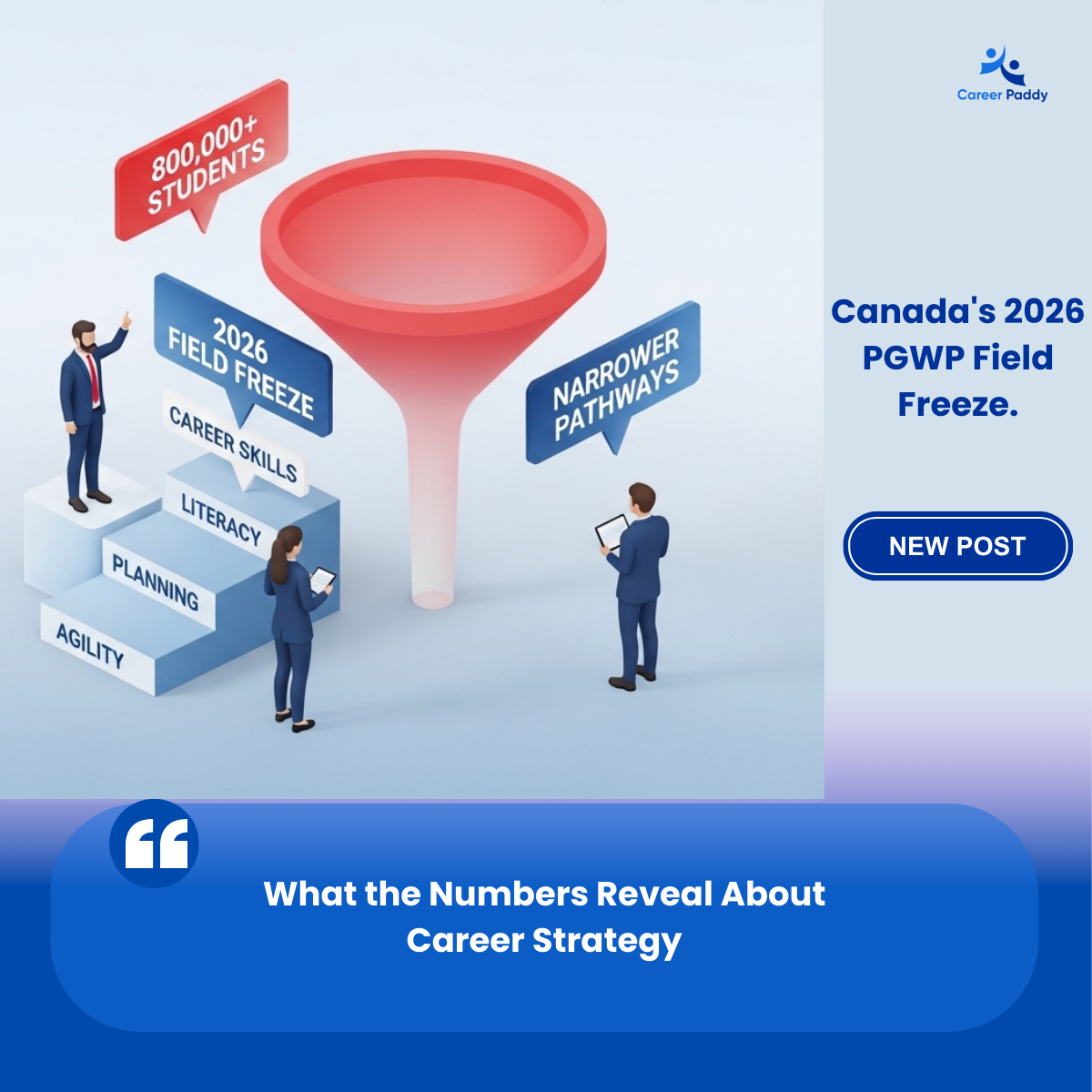
What the Numbers Reveal About Career Strategy
Recent reporting confirms that Canada will freeze eligible fields of study for the Post-Graduation Work Permit (PGWP) starting in 2026, restricting eligibility to programmes aligned with labour market priorities.
According to coverage on Canada PGWP changes 2026, the update applies to new international students enrolling from 2026 onward, affecting study-to-work transitions across multiple disciplines.
Rather than interpreting policy intent, this analysis examines what the available data points and structural shifts reveal about career planning and soft skills.
1. Field-Based Restrictions Affect a Large Share of International Students
- Eligibility will be limited to selected fields, rather than broadly available
- Programmes outside labour-aligned categories may no longer qualify
- The change primarily affects students enrolling from 2026, not those already studying
Canada currently hosts over 800,000 international students, with PGWP historically serving as a primary transition pathway from education to employment.
Reports referencing PGWP eligible fields freeze 2026 indicate that:
Analytical implication
When access narrows at scale, career outcomes depend less on presence in the system and more on positioning within it.
Career skill highlighted: Career Literacy
Understanding how policy timelines intersect with education timelines becomes a core career capability.
2. Labour-Market Alignment Prioritises Fewer, More Specific Skill Pathways
Canada’s labour-aligned education approach is not new. Over the past 3–5 years, multiple immigration streams have shifted toward:
- Targeted occupations
- Priority sectors
- Skills-based filtering
Coverage on Canada labour market–aligned study programmes suggests that:
- Priority lists typically cover a minority of total academic programmes
- Demand-driven sectors change every 1–3 years
- Field relevance is reassessed more frequently than degree completion cycles
Analytical implication
Fixed degrees are now evaluated against moving labour targets.
Career skill highlighted: Transferable Skill Articulation
Professionals must demonstrate skills that remain valuable even when sector priorities shift.
3. Policy Change Cycles Are Shorter Than Education Cycles
Most undergraduate and postgraduate programmes span 2–4 years, while immigration and labour policies are now updated on annual or biennial cycles.
The 2026 PGWP update reinforces this mismatch:
- Students starting in 2026 may graduate under different rules than when they enrolled
- Career decisions made at entry may require reassessment before completion
Analytical implication
Career planning can no longer be front-loaded at admission; it must be revisited throughout the programme.
Career skill highlighted: Strategic Career Planning
Scenario planning and periodic reassessment reduce dependency on single outcomes.
4. Increased Selectivity Raises Competition Within Eligible Fields
When eligibility narrows, competition does not disappear — it concentrates.
Reporting on international student work permit changes in Canada consistently shows that:
- More candidates compete for fewer eligible pathways
- Differentiation increasingly occurs through communication, not credentials alone
- Employers assess readiness within eligibility boundaries
Analytical implication
Eligibility determines access, but communication determines selection.
Career skill highlighted: Professional Communication
Clear CVs, interviews, and workplace communication influence outcomes when formal criteria are similar.
5. Continuous Skill Development Offsets Structural Constraints
Across analysis of Canada international education and immigration updates, one trend recurs:
- Professionals with recent, demonstrable skills adapt faster
- Short learning cycles support quicker repositioning
- Skill relevance is assessed continuously, not only at graduation
Analytical implication
Career resilience increasingly depends on learning frequency, not learning volume.
Career skill highlighted: Learning Agility
The ability to acquire and apply skills within short timeframes supports adaptability.
Data-Anchored Summary
The 2026 PGWP field freeze reflects a broader, data-supported shift:
- Large international student populations filtered through narrower pathways
- Labour priorities reviewed on shorter cycles than education programmes
- Increased competition within eligible categories
- Soft skills influencing differentiation under fixed rules
These patterns are observable across multiple countries and systems.
Closing Perspective
Without assessing policy outcomes, the available data highlights one consistent reality:
Career success increasingly depends on:
- Understanding system timelines
- Translating skills across roles
- Communicating value clearly
- Adapting learning strategies continuously
At CareerPaddy, we focus on helping individuals assess and build these career-critical soft skills to remain adaptable within changing structural environments.
You can also access soft skills that can help you balance your career on the CareerPaddy app:
Stay tuned for more analysis from CareerPaddy
#Softskills #CareerSuccess #CriticalThinking #Communication #CareerPaddy #WorkplaceSkills #ProfessionalGrowth #Adaptability #CareerPlanning #PGWP2026 #CareerTips #LifelongLearning
