What Drives Career Success in An Organization?
The most dangerous phrase in business is “That’s how we’ve always done it.” Labelling critical thinking as “common sense” is a convenient way for mediocre organisations to avoid the discomfort of being challenged. Common sense is a collection of prejudices acquired by age eighteen; critical thinking is the active, disciplined deconstruction of those prejudices to find a more efficient truth.
In the 2026 labor market, “knowing things” is a commodity. The ability to interrogate the validity of data and the logic of a strategy is the only high-margin skill left for humans.
Why Critical Thinking Matters
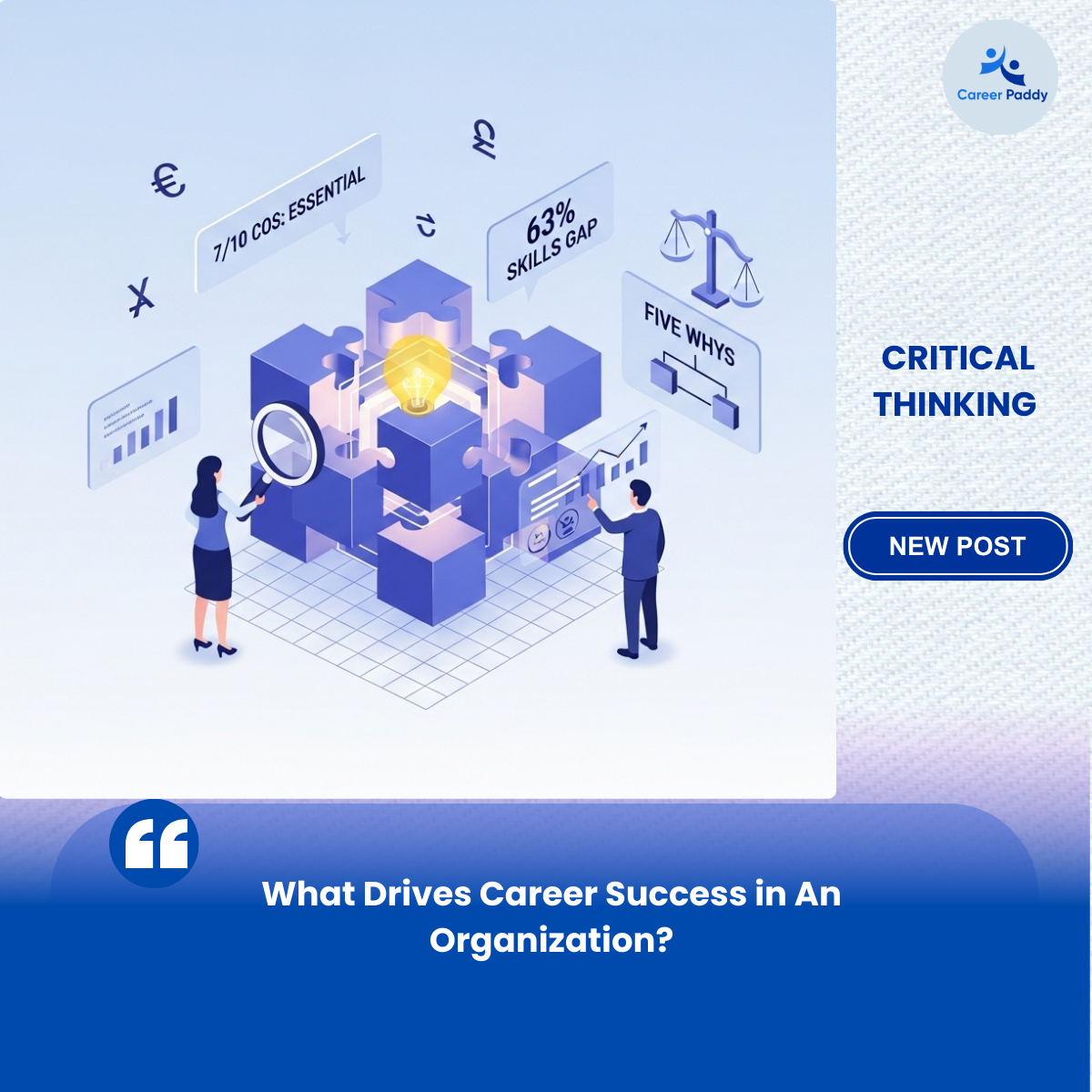
- The Top Priority for Employers: Analytical and critical thinking remain the #1 core skills for global employers in 2026, with 7 out of 10 companies identifying them as essential for navigating rapid technological change (World Economic Forum Future of Jobs Report 2025).
- The AI Oversight Requirement: As organizations integrate GenAI, 82% of executives now prioritize “human-in-the-loop” critical thinking to prevent “AI Workslop”, the productivity drain caused by unverified AI outputs (Gartner Future of Work Trends 2026).
- Strategic Growth Catalyst: Organizations that actively prioritize deep critical thinking and process redesign are twice as likely to exceed their revenue goals compared to those simply adopting new tools (Gartner, 2026).
- The Skill Shortage Crisis: Despite its value, 63% of employers cite the gap in critical thinking and complex problem-solving as the single biggest barrier to their business transformation (World Economic Forum, 2025).
- Retention and Mobility: Professionals with high scores in “Critical Thinking & Business Strategy” see significantly higher rates of internal mobility and job promotions, as these skills are the hardest to replace via automation (LinkedIn Workplace Learning Report 2025).
Common Misconception
The misconception is that being a “critical thinker” means being a “naysayer.” This confusion leads to the suppression of vital dissent. Critical thinking isn’t about finding reasons to say “no”; it is about identifying the specific conditions required to say “yes” with confidence. It is a generative process, not a purely subtractive one.
How to Build Critical Thinking
- Steel-manning the Opposition: Instead of attacking a colleague’s weak idea ,attempt to build the strongest possible version of their argument. If your counter-argument still holds, your logic is sound.
- First Principles Thinking: Deconstruct a problem to its fundamental truths. Stop asking “Which software should we buy?” and start asking “What is the challenges we are trying to solve?”
- The “Five Whys” Root Cause Analysis: When a failure occurs, ask “Why?” five times. Usually, the first “Why” identifies a person to blame, while the fifth “Why” identifies a broken system to fix.
- Probabilistic Thinking: Stop thinking in binaries (Success/Failure). Start thinking in percentages. Ask: “What is the 70% confidence interval for this project’s ROI?”
- Information Hygiene: Curate your inputs. If you only consume industry-specific news, your thinking will be as stagnant as your competitors’. Cross-pollinate your logic with mental models from physics, biology, and architecture.
In Summary
Critical thinking is the ultimate “meta-skill.” It dictates the effectiveness of every other soft skill you possess. You cannot communicate effectively if your logic is flawed; you cannot lead a team if you cannot navigate complex variables; and you cannot innovate if you are trapped by “common sense.”
In 2026, the marketplace rewards those who can think for themselves. Those who rely on the collective “common sense” of the herd will inevitably follow that herd into irrelevance.
You can visit CareerPaddy for more information that can guide you through your career.
You can also access soft skills that can help you balance your career on the CareerPaddy app:
Stay tuned for more analysis from CareerPaddy
