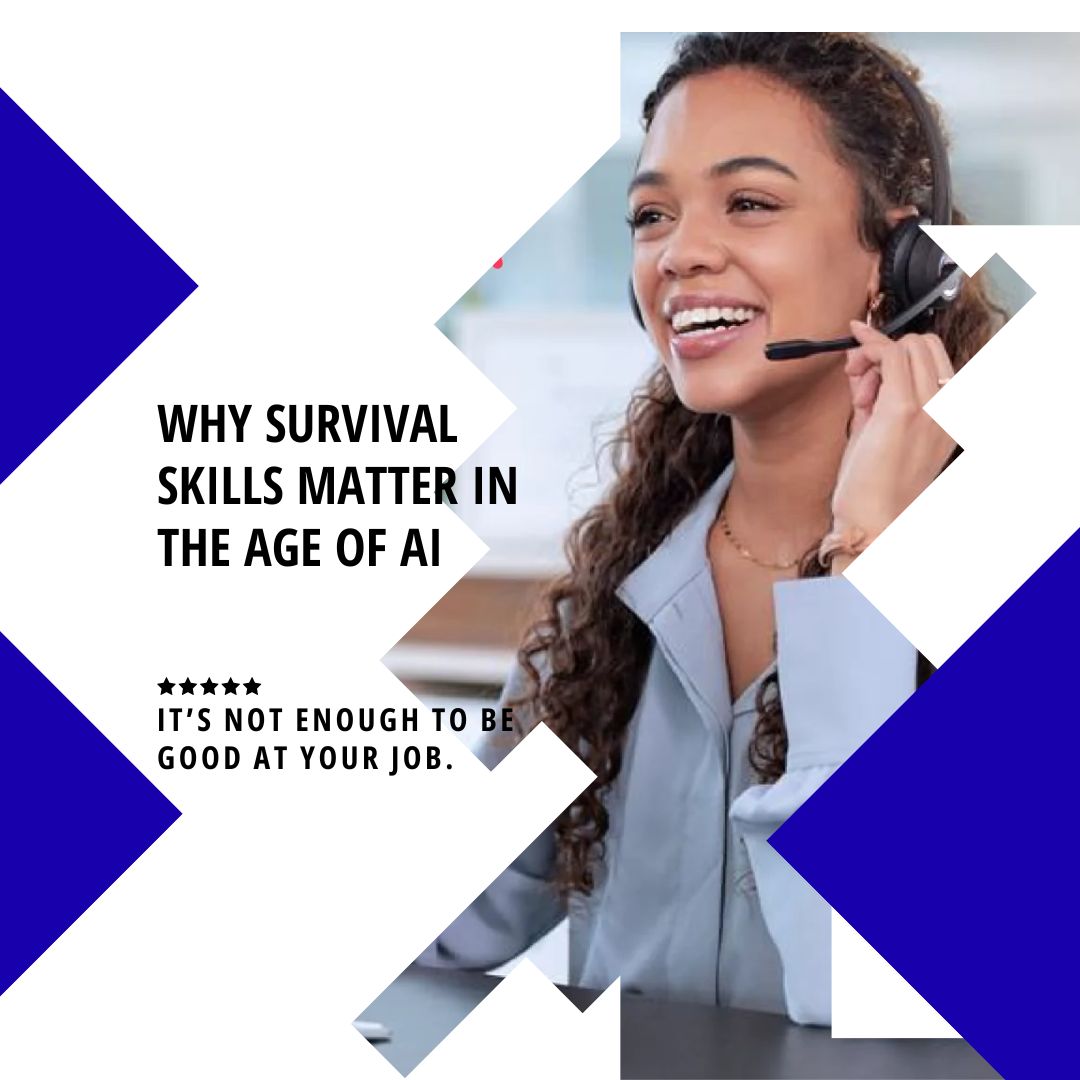
It’s Not Enough To Be Good at Your Job.
Do you know that 80% of workers say soft skills are more important now than ever?
A recent survey by Wiley found that 80% of respondents believe soft skills are increasing in importance as AI takes over more routine tasks. newsroom.wiley.com
Even more striking: 72% of frequent AI users say oral communication will become far more critical while reliance on traditional written communication may decline. (World Economic Forum)
In short: AI may handle the data, but humans still handle the relationships, trust, context, and that’s where survival skills step in.
Consider Tunde’s story.
Tunde was an excellent software developer. He could write code faster than most. But when his company introduced AI-based automation, his role shifted: he now had to partner with the machine, lead a small team, and communicate with stakeholders.
Despite his technical brilliance, he struggled. He couldn’t explain project limitations, handle change discussions, or support junior teammates.
Within months, his confidence was affected and his role began to shrink.
Then he shifted focus: he practiced clear communication, learned how to engage stakeholders, and developed resilience to change. Suddenly, his value grew, he didn’t just work with AI; he led people and technology.
Here’s the real problem:
Technical skill alone isn’t enough anymore. With AI automating more tasks, what remains uniquely human—and therefore crucial—is: empathy, communication, adaptability, and leadership.
The World Economic Forum reports that the importance of human-centered skills has grown by around 20% since 2018, especially as AI adoption spreads. (World Economic Forum)
Employers aren’t asking: “Can you use the tool?” They’re asking: “Can you work with the tool, collaborate with people, adapt when roles shift?”
The shift you need to make
To stay relevant, your mindset must move from “I can do the job” to “I can work with people, machines, and change.”
Survival skills make your expertise visible, your impact lasting, and your career future-proof.
Whether you’re in tech, marketing, logistics, or healthcare — it’s not just what you know, it’s how you connect, adapt, and lead.
Final thought:
It’s not enough to be good at your job.
In today’s world, the strongest players won’t just know the tools, they’ll know how to use them alongside humans.
So train your survival skills. Because the future of work still belongs to people who connect, adapt, and lead where machines cannot.
You can visit CareerPaddy for more information that can guide you through your career
You can also access soft skills that can help you balance your career on the CareerPaddy app
Stay tuned for more analysis from CaeerPaddy
#CareerPaddy #SurvivalSkills #FutureOfWork #SoftSkills #CareerGrowth #AIandWorkplace

Amazing Analytics