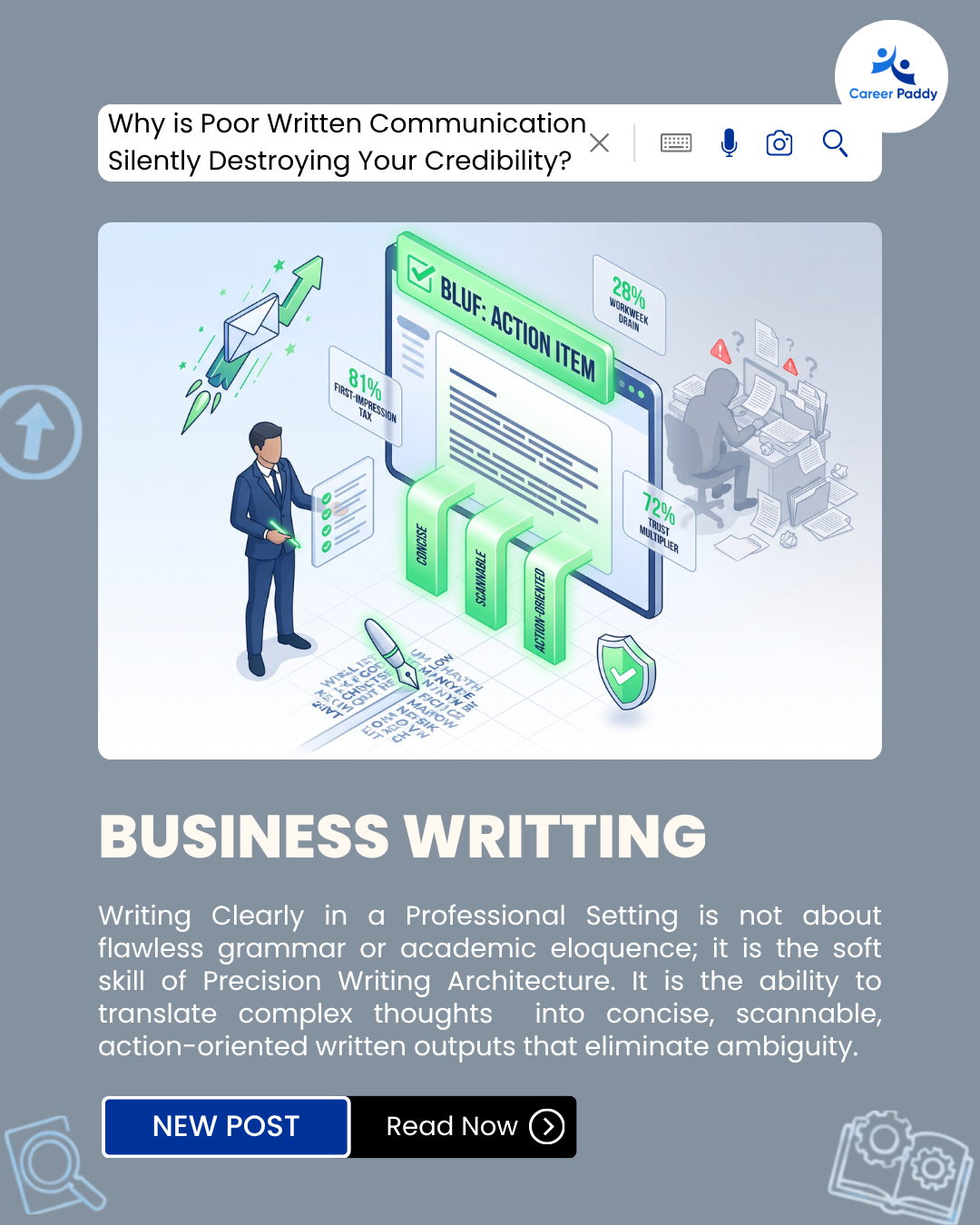
Why is Poor Written Communication Silently Destroying Your Credibility?
How long is enough whenever you are polishing an email?, after double‑checking the facts, after attaching the file, and hitting send, only to get a reply two hours later: “What exactly do you need from me?” That isn’t a miscommunication; it’s a writing failure. And it’s happening far more often than you realize.
In entry‑level roles, many treat business writing as an afterthought. They fire off emails riddled with typos, send WhatsApp voice notes instead of a concise two‑line update, and submit reports that read like rambling essays, forcing managers to decode the real point.
Writing Clearly in a Professional Setting is not about flawless grammar or academic eloquence; it is the soft skill of Precision Writing Architecture. It is the ability to translate complex thoughts and stakeholder requests into concise, scannable, action-oriented written outputs that eliminate ambiguity. In 2026, where remote and hybrid workflows have made written communication the dominant mode of professional interaction, a junior professional who writes with surgical clarity is an operationally rare asset.
Why Business Writing Matters
- The First-Impression Tax: Over 81% of hiring managers report that poorly written application materials, including cover letters and follow-up emails, are the single fastest disqualifier for entry-level candidates. Your technical qualifications become irrelevant the moment your writing signals carelessness (NACE Job Outlook Survey).
- The Productivity Drain: Employees spend an average of 28% of their workweek reading and responding to emails. Poorly structured messages force recipients to re-read them 2 to 3 times before extracting the core action item. This costs organizations an estimated ,041 per knowledge worker annually in lost productivity (McKinsey Global Institute).
- The Trust Multiplier: 72% of business leaders confirm that clear, well-structured written communication directly increases their trust in a team member’s overall competence. They judge your writing before they ever review your technical output (Grammarly and Harris Poll Workplace Study).
- The Promotion Filter: Early-career workers who consistently produce clear, concise, and well-formatted written communication are advanced into client-facing roles 2.5x faster than peers who rely solely on verbal ability. If you write well, leadership notices you sooner (LinkedIn Workplace Learning Report).
Common Misconception
The misconception is that good business writing means using long, complex sentences filled with corporate jargon to sound professional. You have seen it before: a colleague sends a 400-word email when three sentences would do, or drops “per our last correspondence” and “kindly revert at your earliest convenience” into a simple WhatsApp update. This inflated approach backfires, because it buries the core message under unnecessary complexity. Recipients skim past the critical action points entirely.
True professional writing is about Ruthless Clarity. It means stripping every sentence down to its essential instruction. It means organizing information so the reader never has to guess what you need from them. And it means respecting the recipient’s time as aggressively as you protect your own.
How to Master Precision Writing Architecture
- Deploy the “Bottom Line Up Front” (BLUF) Rule: Never bury your core request at the end of an email. State your primary ask in the very first sentence. Lead with: “I need your sign-off on the revised Q3 campaign budget by 2:00 PM today. Context below.” If the recipient only reads two lines, they still know exactly what you need.
- Enforce the One-Email, One-Action Principle: Every email you send should contain exactly one clear request or one defined update. If you have three separate action items, send three short, labelled emails. This prevents critical tasks from getting buried in a wall of text.
- Strip Out Filler Language Ruthlessly: Erase phrases like “I just wanted to touch base,” “I hope this email finds you well,” and “Please do not hesitate to reach out.” Replace them with direct language: “Updating you on the deliverable status” or “Requesting your input on the revised timeline.”
- Structure Every Report for Scanning: Use bullet points, numbered lists, bold headers, and short paragraphs in every written deliverable. Your manager should extract the three most important data points from your report in under 15 seconds. If your writing requires a full read-through to make sense, you have failed the formatting test.
- Proofread with a 5-Minute Buffer: Before hitting “Send,” build in a mandatory 5-minute cooling period. Re-read the message checking three things: Is the action item in the first two sentences? Are there ambiguous pronouns like “it” or “this” that could confuse the reader? Would someone unfamiliar with the project understand the message?
- Adapt Your Tone to the Channel: A formal project update to a department head requires different structure than a quick Slack ping to a teammate. In the West African corporate ecosystem, where WhatsApp is frequently used for business communication, this boundary is especially critical. Your WhatsApp status update to a colleague can be informal, but your email to an external client must maintain full professional formatting and a clear sign-off.
In Summary
You can be the most technically brilliant person on your floor. But if your emails read like a group chat and your reports require a decoder ring, leadership will never know it. Every poorly written email quietly erodes the professional credibility you are trying to build.
By shifting from casual, reactive messaging to systematic Precision Writing Architecture, you take complete ownership of how your competence is perceived. You stop being the team member whose emails get skimmed and ignored. You become the professional whose written outputs get forwarded to leadership as the standard. Master the structure, eliminate the noise, and let your written clarity dictate your market value.
You can visit CareerPaddy for more information that can guide you through your career.
You can also access survival skills courses on Business Writing on
Career Paddy App on Play Store
Career Paddy App on Apple Store
Stay tuned for more analysis from CareerPaddy
#SoftSkills #SurvivalSkills #CareerGrowth #WorkplaceSuccess #CareerPaddy #CareerTips #BusinessWriting #ProfessionalCommunication #EmailEtiquette #WorkplaceCommunication
