In Summary
Why is Workplace Friction Quietly Ruining Your Career Growth?
You are in a team sync, and a colleague criticizes your project proposal in front of your manager. Your chest tightens, your blood pressure spikes, and your instant instinct is to fire back with a defensive rebuttal to protect your ego. By the time the call ends, you might feel like you won the debate, but your manager marks you down as difficult, reactive, and unsafe to put in high-stakes client meetings. That isn’t standing up for yourself; it’s a conflict management failure.
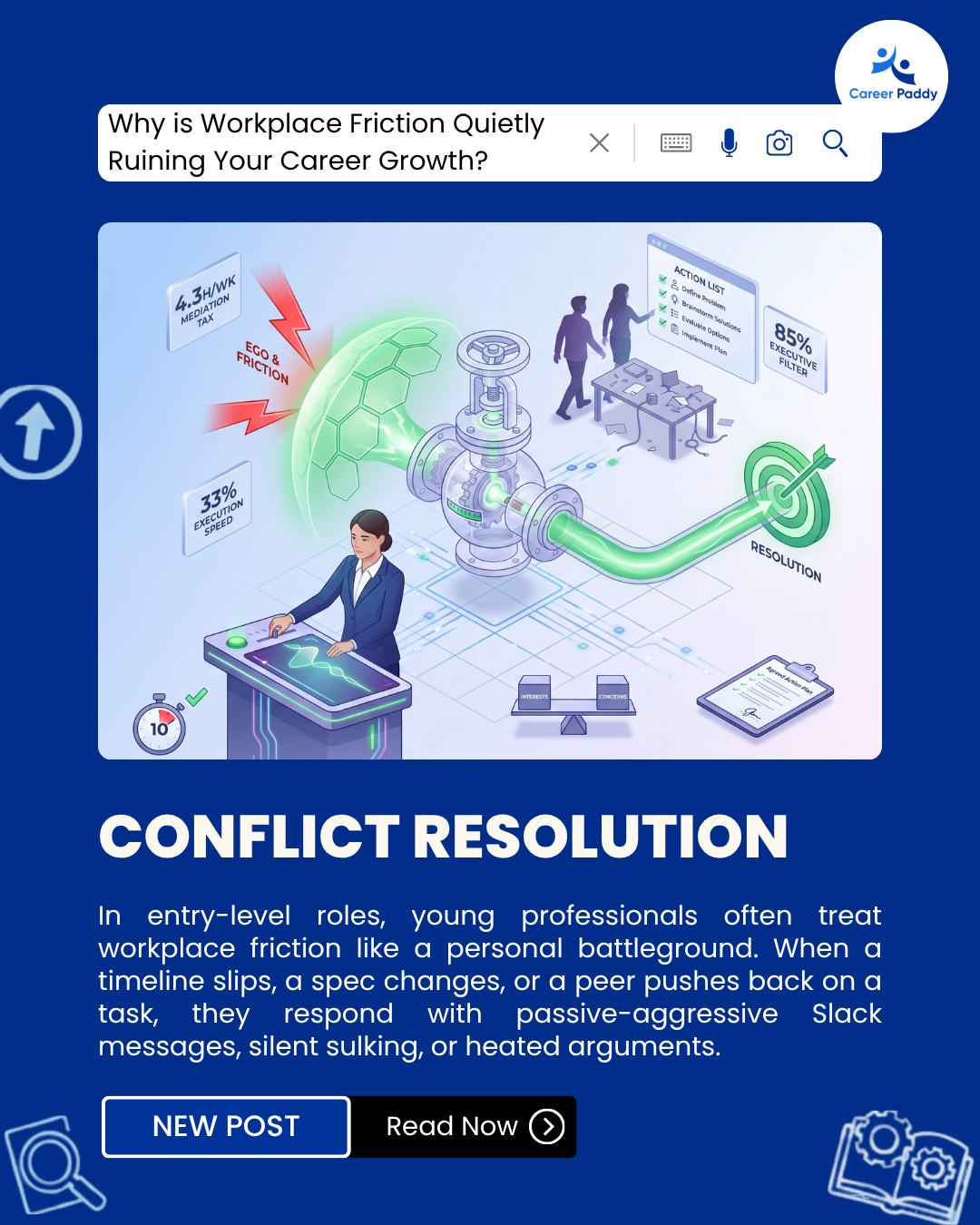
In entry-level roles, young professionals often treat workplace friction like a personal battleground. When a timeline slips, a spec changes, or a peer pushes back on a task, they respond with passive-aggressive Slack messages, silent sulking, or heated arguments. In a fast-paced corporate execution loop, escalating friction creates immediate operational bottlenecks. Leadership moves reactive team members out of core projects because managing their emotional volatility takes too much energy.
Handling Workplace Friction is not about avoiding hard conversations or pretending to agree with everyone; it is the soft skill of De-escalation Architecture. It is the systematic ability to separate professional disagreement from personal ego, isolate the root operational bottleneck, and guide conflicting parties toward a measurable resolution. In 2026, where cross-functional team dependencies are tighter than ever, a junior professional who can neutralize friction and keep projects moving is a high-value asset.
Why Conflict Resolution Matters
- The Time Drain Tax: Managers spend an average of 4.3 hours per week mediating interpersonal workplace disputes and team friction. Early-career professionals who resolve friction independently save leadership valuable operational time (SHRM Workplace Conflict Study).
- The Retention Impact: Toxic, unresolved team friction accounts for over 24% of voluntary employee resignations within the first year of employment. Learning how to de-escalate tension protects overall team stability (Harvard Business Review Leadership Study).
- The Productivity Multiplier: Organizations with structured conflict management frameworks report a 33% increase in cross-functional project completion speeds. Resolving friction quickly keeps execution loops on track (Project Management Institute).
- The Leadership Filter: Over 85% of executive leaders identify emotional composure and de-escalation skills as essential prerequisites before promoting junior staff into managerial positions. If you handle friction calmly, leadership trusts you with greater responsibility (NACE Career Readiness Framework).
Common Misconception
The misconception is that conflict resolution means staying silent, taking the blame, or pleasing everyone just to keep the peace. You have seen it before: a junior staff member yields on a critical project requirement simply to avoid an uncomfortable conversation, leading to project failure down the line. That passive approach backfires because unaddressed issues accumulate into resentment and larger operational breakdowns.
True professional de-escalation is about Ruthless Objectivity. It means addressing disagreements directly without emotional drama. It means shifting the focus from “Who is at fault?” to “What operational fix does the project need right now?”
How to Master De-escalation Architecture
- Separate the Problem from the Person: Depersonalize the disagreement immediately during team discussions. Instead of saying “You forgot to send the file,” reframe it as “The file hasn’t arrived in the shared folder yet.” This shifts the team focus from personal accusation to process troubleshooting.
- Enforce the 10-Second Pause Before Responding: Never reply to a hostile email or critical comment while your adrenaline is pumping. Take 10 seconds to regulate your breathing and calm your nervous system before speaking or typing. This prevents reactive words that damage long-term professional relationships.
- Use Active Listening Verification: Before offering your counter-proposal, restate the other person’s point to prove comprehension. Say: “What I hear you saying is that the current delivery timeline risks compromising data accuracy—is that correct?” This lowers their defensive guard instantly because they feel understood.
- Shift the Narrative from Past Blame to Future Action: Avoid looping over past mistakes once an error occurs. Pivot the conversation immediately by asking: “What specific step can we take in the next two hours to unblock this deliverable?” Focusing on immediate action channels nervous energy into problem-solving.
- Document Agreed Resolutions in Writing: Conclude every friction-heavy meeting with a written summary sent to all participants. Outline the core decision, assigned owners, and agreed deadlines in clear bullet points. This eliminates selective memory and keeps everyone accountable.
- Choose the Right Communication Medium: Stop having complex disagreements over text-based channels like Slack or WhatsApp. In the West African corporate environment where text tone is easily misread, pivot to a brief voice or video call: “Let’s hop on a 5-minute call to align on this quickly.” A short call resolves misunderstandings faster than twenty back-and-forth text messages.
You can have exceptional technical talent, but if team members walk on eggshells around you, your growth ceiling will remain low. Volatile reactivity quietly signals to leadership that you are not ready for larger responsibilities.
By shifting from emotional confrontation to systematic De-escalation Architecture, you take complete control of your professional presence. You stop being the person who triggers team drama and become the calm anchor who solves problems. Master the composure, focus on solutions, and let your professional maturity accelerate your career.
You can visit CareerPaddy for more information that can guide you through your career.
You can also access survival skills courses on Conflict Resolution on
Career Paddy App on Play Store
Career Paddy App on Apple Store
Stay tuned for more analysis from CareerPaddy
#SoftSkills #SurvivalSkills #CareerGrowth #WorkplaceSuccess #CareerPaddy #CareerTips #ConflictResolution #DeEscalation #Professionalism #Teamwork
