Why the “I Can Do It Faster Myself” Mindset is a Management Failure
A master chef opened a high-end restaurant after years of culinary acclaim. On opening night, the kitchen was overwhelmed with orders.
Instead of directing the kitchen and inspecting finished plates, the chef panicked.
He pushed a junior cook aside, started chopping onions, searing fish himself, he told himself that nobody else could do it fast enough.
While the chef cooked two perfect dishes, thirty dining tables waited forty-five minutes. Orders got mixed up. The entire dining room descended into chaos.
The Trap of the Hero Individual Contributor
In corporate leadership, newly promoted team leads make this exact mistake every single day.
They got promoted because they were exceptional individual executors. But when deadlines approach, they revert to their old habits.
They rewrite junior staff presentations at midnight,take back delegated spreadsheet and fix code errors themselves instead of coaching their team.
They believe doing the work themselves guarantees quality.
In reality, it is a severe management failure.
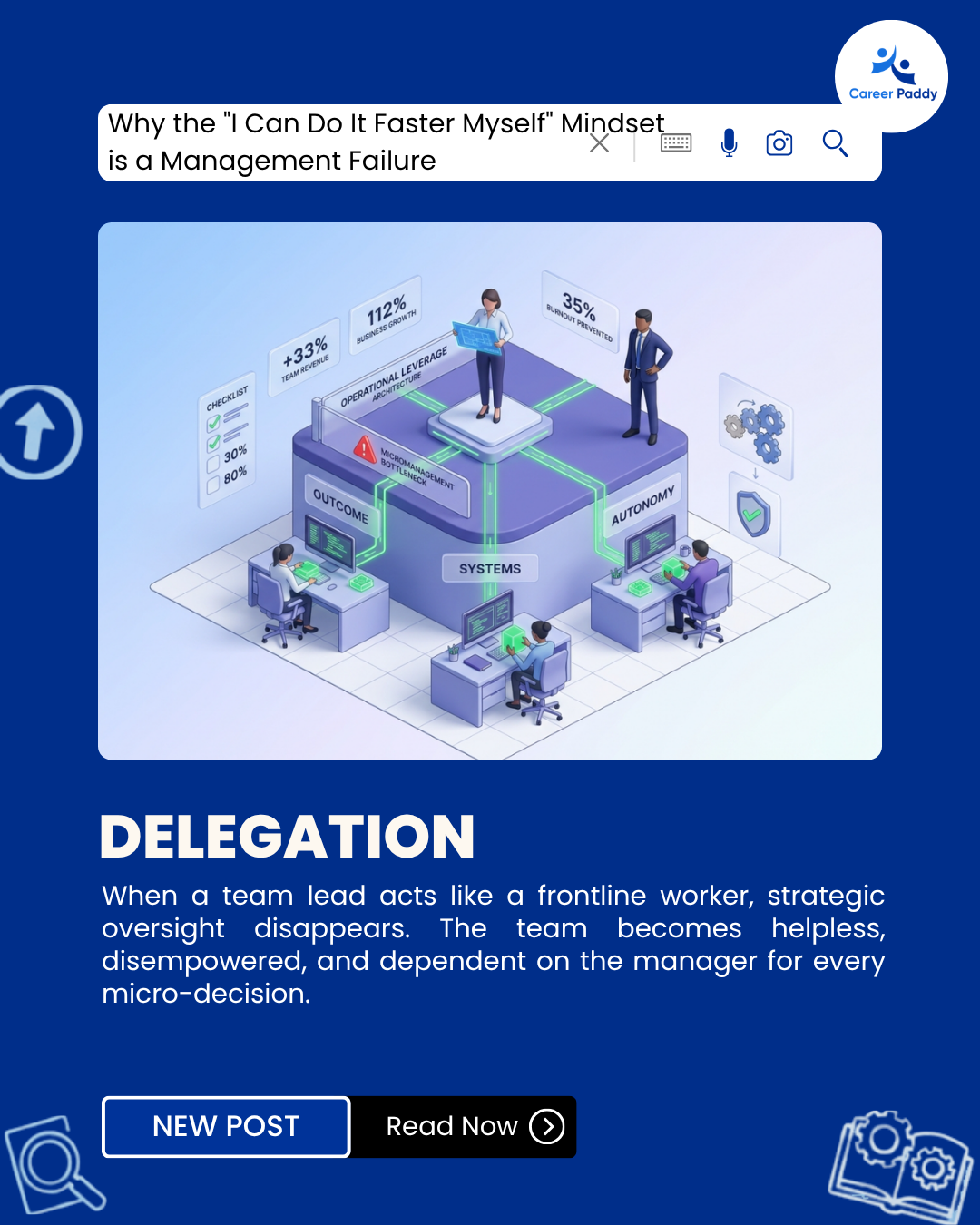
When a team lead acts like a frontline worker, strategic oversight disappears. The team becomes helpless, disempowered, and dependent on the manager for every micro-decision.
Leadership is not about executing tasks faster than your direct reports. It is the soft skill of Operational Leverage Architecture.
It is the discipline of building systems, setting clear parameters, and multiplying results through others.
Why Delegation Matters
The Revenue Growth Factor: Research published in the Harvard Business Review reveals that managers who delegate effectively generate 33% higher team revenue. Empowering direct reports expands overall operational bandwidth.
The Executive Performance Multiplier: Studies by Gallup Workplace Analytics show that leaders with high delegation talent achieve 112% higher business growth rates. Delegating routine execution frees time for strategic planning.
The Early Burnout Risk: Research from the Stanford Graduate School of Business shows that 35% of first-time managers burn out within twelve months. Inability to delegate is the leading cause of leadership fatigue.
The Promotion Differentiator: Over 87% of corporate executives rank systemic delegation and team development as the top criteria for senior director promotions (NACE Career Readiness Framework). Executives look for force multipliers, not overworked heroes.
The Common Misconception
Many managers confuse delegation with either micromanagement or total abdication.
Abdication means dumping a task on a junior colleague and disappearing without guidance. Micromanagement means hovering over their desk and dictating every mouse click.
Both approaches destroy productivity.
True delegation is about Outcome Sovereignty.
You define the final standard, establish clear constraints, and agree on review milestones. But you grant your direct reports full autonomy over the execution path.
Micromanagement creates bottlenecked employees. Systemic delegation builds independent leaders.
How to Master Operational Leverage Architecture
Apply the 70% Capability Rule: If a team member can perform a task at 70% of your standard, delegate it immediately. Do not wait for perfection before handing over responsibility. Coaching them through that final 30% gap is how you scale your team’s competence.
Delegate the Outcome, Not the Exact Steps: Explain clearly what success looks like and when the deliverable is due. Allow your team member to decide how to reach that objective. Giving ownership over the process drives engagement and problem-solving.
Establish Milestone Checkpoints Early: Set structured review gates at 30% and 80% project completion. This allows you to catch directional errors early without hovering over daily work. Planned checkpoints eliminate the need for panic inspections near the deadline.
Refuse to Accept “Returned Monkeys”: When a subordinate brings you a problem and asks what to do, do not solve it for them. Ask: “What are your two proposed solutions, and which one do you recommend?” Training your team to bring solutions stops you from carrying their workload.
Build Standard Operating Procedures (SOPs): Document routine operational processes into clear checklists and templates. Documented workflows allow team members to execute repeatable tasks with consistent quality. Good systems reduce the need for constant managerial intervention.
Structure Redundancy for Local Disruptions: In the West African corporate ecosystem, sudden power cuts and transit delays happen regularly. Cross-train team members on critical accounts so project handovers occur smoothly. Operational oversight requires building resilient teams that thrive during unexpected absences.
In Summary
You will never scale your impact if your hands are always on the operational tools.
If you insist on doing everything yourself, you are not leading. You are merely an individual contributor with an exhausting management title.
Step back from the cooking line. Inspect the systems, empower your team, and let your leadership multiply your organization’s results.
Because in executive management, your value is measured by what your team achieves without you.
You can visit CareerPaddy for more practical resources on leadership development and survival skills.
Access survival courses on Delegation & Team Leadership on:
Career Paddy App on Play Store
Career Paddy App on Apple Store
Stay tuned for more career insights from CareerPaddy.
#Leadership #Management #Delegation #CareerGrowth #WorkplaceSuccess #CareerPaddy #TeamLeadership #Productivity #OperationalExcellence #TeamBuilding
