Why is “Staying Cool” a Career Power Move?
In an entry-level role, the pressure to perform can feel like an emotional assault. A critical feedback session, a missed deadline, or a difficult client can trigger an immediate “fight or flight” response. However, treating your emotions as commands shouting when frustrated or withdrawing when overwhelmed is the fastest way to stall your career.
Emotional Regulation is the soft skill of Objective Processing. It is the ability to acknowledge a feeling, analyze its source, and choose a response that serves your long-term goals rather than your short-term impulse. In 2026, the most valuable employees are those who can navigate a crisis without becoming part of it.
Why Managing Emotions Matters
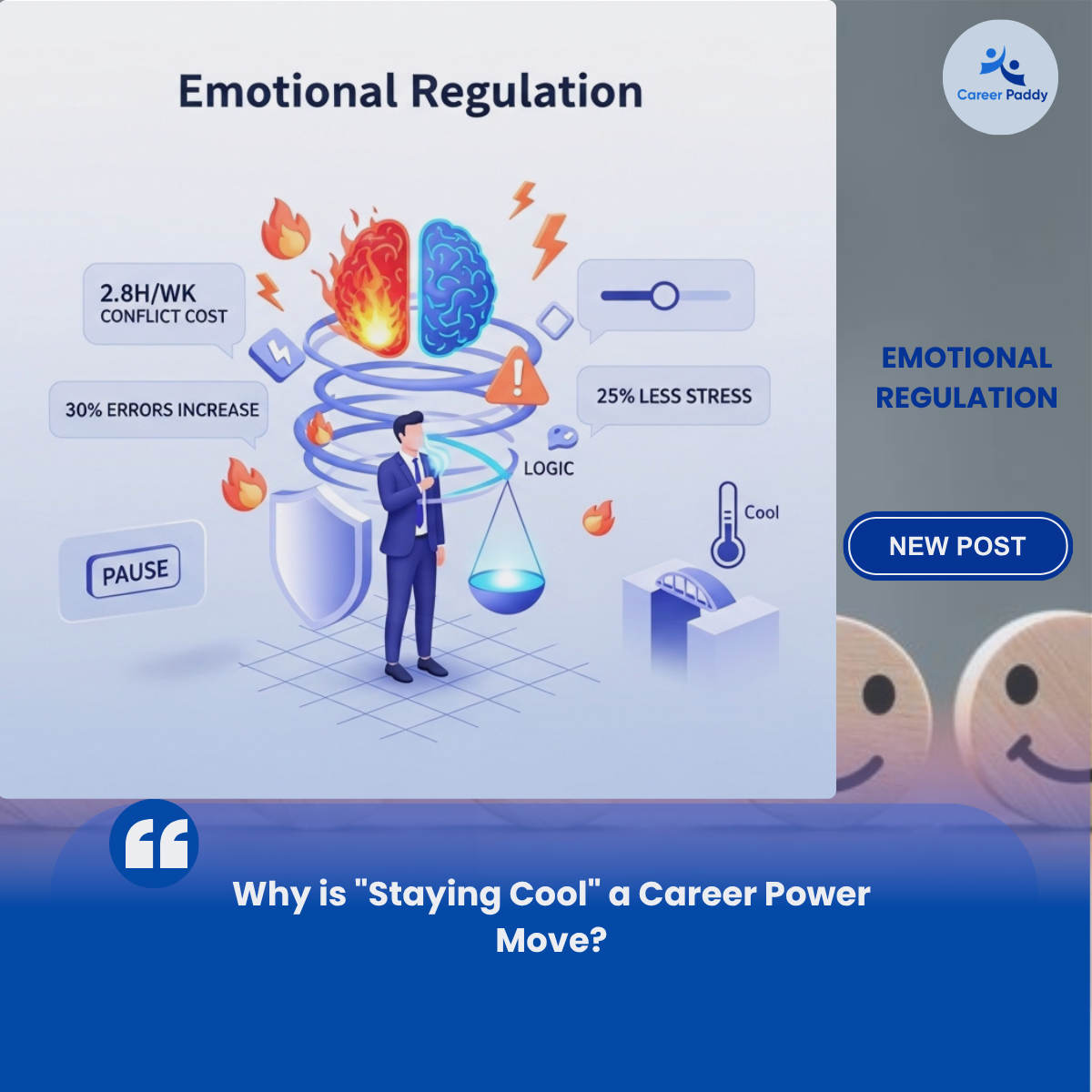
- The Conflict Cost: Unmanaged workplace conflict, often driven by poor emotional regulation, consumes an average of 2.8 hours per week per employee, costing U.S. businesses roughly $359 billion in paid hours annually (CPP Global Human Capital Report, 2024).
- Leadership Desirability: 86% of employees report that they would prefer to work for a manager who stays calm under pressure, and these managers see 20% higher team engagement (Gartner Digital Workplace Survey, 2025).
- Decision-Making Accuracy: High emotional arousal (stress/anger) is proven to reduce the prefrontal cortex’s capacity for logic, leading to a 30% increase in critical errors during high-stakes tasks (Nature Human Behaviour, 2024).
- Peer Influence: Professionals who demonstrate emotional stability are 50% more likely to be sought out for collaborative projects, increasing their visibility and promotion potential (LinkedIn Workplace Learning Report, 2026).
- The Burnout Shield: Early-career professionals who master “Reframing” (an emotional regulation technique) report 25% lower levels of work-related stress than those who do not (World Economic Forum, 2025).
Common Misconception
The misconception is that managing emotions means “being a robot” or having no feelings at all. This is impossible and unhealthy. Real emotional regulation is about Observation. You don’t ignore the anger; you look at the anger and say, “I am feeling angry because I feel undervalued. How can I communicate my value professionally instead of reacting to the anger?”
How to Manage Emotions in the Workplace
- The “Gap” Strategy: When you receive a triggering email or comment, create a physical gap. Walk away, get water, or count to ten. This prevents your amygdala (the emotional center) from hijacking your prefrontal cortex (the logic center).
- Cognitive Reframing: Change the narrative. Instead of thinking, “My boss hates my work,” reframe it to, “My boss is under pressure and wants this project to succeed, which is why the feedback is intense.”
- The “Six-Second” Pause: It takes six seconds for emotional chemicals to dissipate in the brain. If you can wait six seconds before speaking, your logic will likely override your impulse.
- Labeling the Emotion: Mentally say, “I am feeling (Anxiety/Frustration/Shame).” Research shows that simply labelling an emotion reduces its intensity.
- Focus on the “Next Best Step”: When overwhelmed, ignore the big picture. Ask yourself: “What is the one, small, logical thing I can do in the next five minutes?” This shifts the brain from “Panic Mode” to “Solve Mode.”
- Box Breathing: Use the 4-4-4-4 technique (inhale for 4, hold for 4, exhale for 4, hold for 4). This physically signals your nervous system to exit the “Fight or Flight” state.
In Summary
Your emotions are powerful signals, but they are terrible masters. By learning to regulate your internal state, you gain control over your external environment.
In 2026, the workplace is volatile and fast-paced. The professionals who can remain grounded while others are panicking aren’t just “balanced”—they are leaders in the making. Emotional regulation is the difference between reacting to the world and shaping it.
You can visit CareerPaddy for more information that can guide you through your career.
You can also access survival skills courses on Emotional Regulation on
Stay tuned for more analysis from CareerPaddy
#SoftSkills #SurvivalSkills #CareerGrowth #WorkplaceSuccess #CareerPaddy #CareerTips #EmotionalIntelligence #StressManagement #Professionalism
