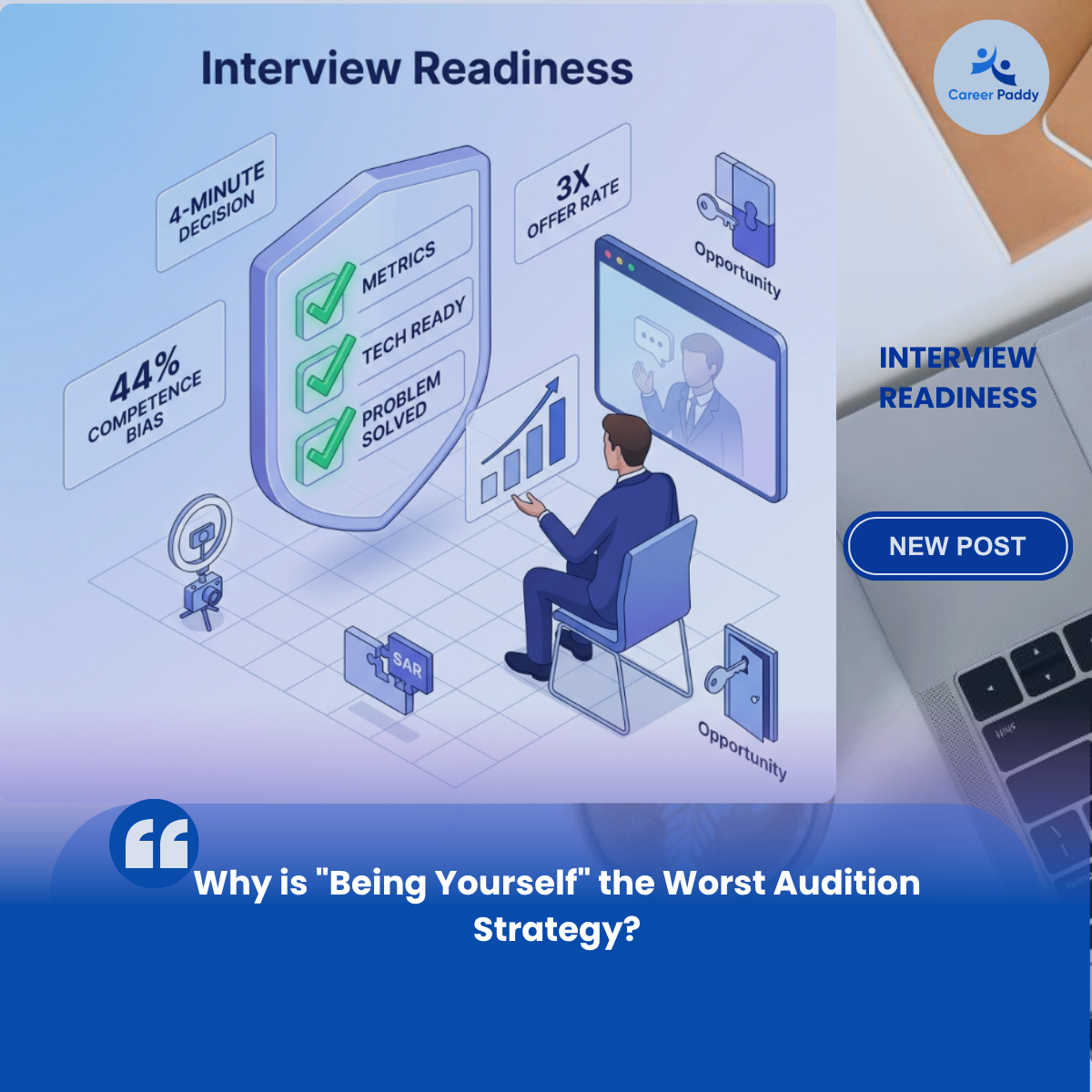
Why is “Being Yourself” the Worst Audition Strategy?
The most common piece of interview advice given to young professionals is to “just be yourself.” In a high-stakes hiring environment, this is remarkably lazy advice. An interview is not a casual social chat; it is a high-density capability audition. Hiring managers are not looking for a friend; they are looking to solve an operational problem and eliminate risk.
Interview Readiness is the soft skill of Strategic Positioning. It is the ability to map your existing skills directly to a company’s pain points within the first five minutes of interaction. In 2026, where a single remote role can attract thousands of global applicants, treating an interview as a casual conversation ensures you will remain unhired.
Why First Impressions Matter
- The Proficiency Chasm: According to research, a staggering 78.1% of entry-level candidates believe they communicate effectively, yet only 53.5% of hiring managers agree, highlighting a massive perception gap that sinks candidates early in the session (NACE Perception Gap Research, 2025).
- The Promotion Fast-Track: Candidates who demonstrate structural, calm verbal presentation in small group interviews are 44% more likely to be fast-tracked into management consideration downstream (Forbes Demand Survey, 2024).
- The Cost of Bad Hiring: A bad entry-level hire costs an organization an average of $15,000 in wasted salary and recruitment overhead, making managers highly risk-averse during interviews.
- The Tech-Check Penalty: In remote interviews, 62% of recruiters state that poor lighting, unstable audio, or basic tech glitches instantly lower a candidate’s evaluation score, regardless of their resume quality.
- The Alignment Premium: Job seekers who can explicitly connect their presentation skills to managing modern workspace friction see a 3x higher offer rate than those who give generic answers (LinkedIn Workplace Learning Report, 2025).
Common Misconception
The misconception is that the candidate with the most decorated resume or the highest technical grade automatically gets the job. This is false. Technical capability is simply the ticket that gets you into the room. The job goes to the professional who makes the manager feel the safest. An interview is an exercise in risk reduction; your goal is to prove that hiring you will make your manager’s life easier, not more complicated.
How to Master the Strategic Audition
- Deploy the “SAR” Framework: Never answer a situational question with a long narrative. Use Situation, Action, Result. State the problem you faced, the precise action you took, and the quantifiable result of that action (e.g., “I redesigned the layout, which cut user drop-off by 15%”).
- Conduct an Pre-Interview Tech Audit: If the interview is remote, your background, lighting, and audio are your stage design. Test your setup 15 minutes before the call. Good lighting and a crisp microphone signal that you take the opportunity seriously.
- Flip the “Tell Me About Yourself” Script: Do not recite your resume chronologically. Use the Past-Present-Future formula: Mention a core skill you developed in the past, how you are applying it to major design or operational projects in the present, and why that specific skill makes you perfect for the company’s future.
- Interview the Company Back: When asked “Do you have any questions for us?”, never say no. Ask high-context, diagnostic questions that show strategic thinking, such as: “What does success look like in the first 90 days for this role?” or “What is the biggest operational bottleneck the team is currently facing?”
- Match and Elevate the Energy: Observe the interviewer’s communication style within the first 60 seconds. If they are direct and metrics-driven, skip the pleasantries and lead with numbers. If they are narrative-focused, anchor your answers in clear case studies.
- Eliminate Uncertain Modifiers: Ban phrases like “I think I can do that,” “I have a bit of experience in,” or “I hope to learn.” Replace them with decisive, high-trust language: “I have executed that process using [Tool X],” or “My approach to that problem is…”
In Summary
An interview is a brief window to pitch your value as a high-margin asset. If you walk into the room hoping to “see how it goes,” you have already conceded the role to someone who prepared a strategy.
By mastering strategic positioning, you transform from a passive job seeker into an operational consultant. You don’t ask for a job; you present a solution. Position yourself cleanly, eliminate the hiring manager’s risk, and let your preparation dictate your market value.
You can visit CareerPaddy for more information that can guide you through your career.
You can also access survival skills courses on Strategic Prescence on
Stay tuned for more analysis from CareerPaddy
#SoftSkills #SurvivalSkills #CareerGrowth #WorkplaceSuccess #CareerPaddy #CareerTips #InterviewPrep #FirstImpressions #JobSearch
