Why Forcing Total Victory Destroys Cross-Functional Coalitions and How Elite Leaders Align Stakeholders
Two contractors were hired to build adjacent wings of a major commercial pavilion.
The first contractor was aggressive and demanding. Whenever the plumbing or electrical crews crossed into his zone, he waved his contract and threatened to report them to the project director.
He won every argument on paper.
Yet quietly, the other trades pushed back. They dragged their feet on inspections, withheld equipment, and refused to coordinate delivery schedules.
His wing was stalled by six months of passive resistance.
The second contractor took a completely different approach.
Before lifting a single beam, he sat down with the master electrician and lead plumber over morning tea.
He did not wave his contract. Instead, he asked a simple question: “Where will your heaviest conduit runs sit, and how can my framing design make your installation faster?”
He adjusted his timber layouts by two inches. That small adjustment saved the electricians three weeks of drilling through concrete.
In return, the electrical crew prioritized his wiring runs and resolved conflicts before they reached the client.
His wing finished a month ahead of schedule and under budget.
The Illusion of Positional Power
The first contractor confused winning arguments with achieving business outcomes.
He treated negotiation as a battleground where one person wins and the other loses.
In senior management, many leaders make this exact mistake when dealing with peer departments.
When launching a new initiative, they demand compliance based on executive mandates or corporate authority.
They push their agenda through sheer force, ignoring the priorities of Finance, Legal, Marketing, or Product.
They might win the meeting today, but they guarantee failure during execution tomorrow.
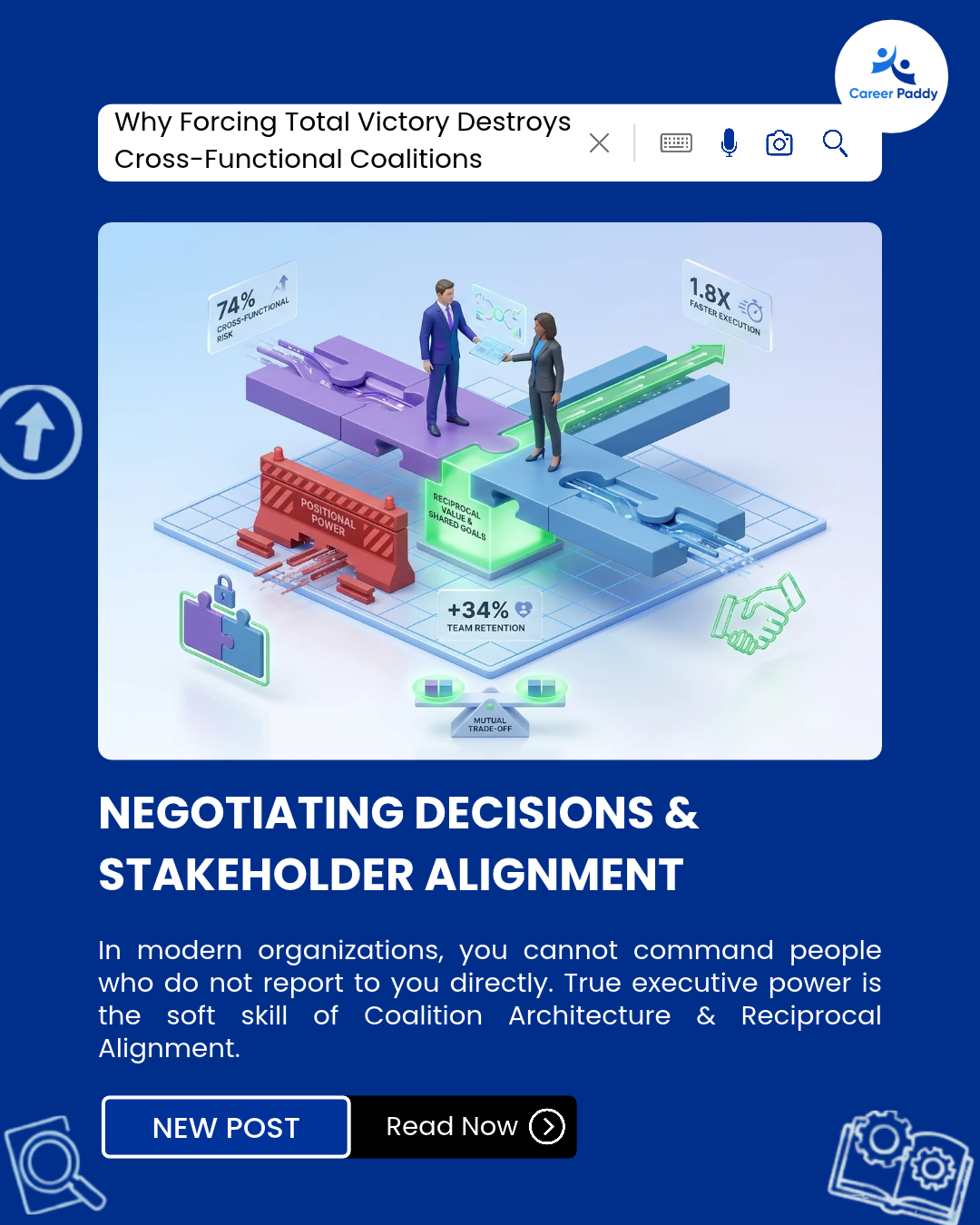
In modern organizations, you cannot command people who do not report to you directly.
True executive power is the soft skill of Coalition Architecture & Reciprocal Alignment.
It is the discipline of discovering what your peers care about and engineering solutions that advance their goals alongside your own.
Why Stakeholder Alignment Matters
The Cross-Functional Reality: Research from the Harvard Business Review reveals that over 74% of cross-functional strategic initiatives fail due to misaligned priorities and departmental turf wars. Collaborative alignment is the primary predictor of execution success.
The Speed Advantage: Studies published by McKinsey & Company demonstrate that organizations with strong cross-departmental alignment execute strategic transformations 1.8x faster than siloed competitors. Mutual trust directly accelerates operational velocity.
The Executive Retention Impact: According to research from the Center for Creative Leadership (CCL), senior managers with high collaborative negotiation skills deliver 34% higher team retention and experience 40% faster career promotion rates.
The Project Risk Multiplier: Over 81% of enterprise project failures trace directly back to unaddressed stakeholder resistance and poor coalition building (Project Management Institute (PMI)).
The Common Misconception
Many professionals believe that negotiation is about compromising or splitting the difference in the middle.
Compromise often leaves both parties dissatisfied and resentful.
When you compromise, you water down the original objective until no one gets what they really need.
Real alignment is not about splitting the difference. It is about discovering non-competing interests.
You give stakeholders what they value most in exchange for what you need to deliver your mandate.
Weak leaders demand compliance through rank. Average managers settle for resentful compromise. Elite executives engineer mutual victories that turn skeptics into champions.
How to Master Coalition Architecture & Reciprocal Alignment
Pre-Wire Decisions Before the Formal Meeting: Never introduce a major proposal cold in a public boardroom. Meet key stakeholders individually beforehand to listen to concerns, address objections quietly, and secure private buy-in ahead of time.
Map Underlying Interests Instead of Stated Positions: Stop arguing over what stakeholders say they want. Dig deeper to understand their underlying pressures, such as budget constraints, team bandwidth, or board visibility.
Trade High-Value, Low-Cost Concessions: Identify resources or workflow adjustments that cost your team very little but provide tremendous relief to your peer’s department. Offering reciprocal value upfront eliminates defensive barriers immediately.
Use the Steel-Manning Technique to Disarm Resistance: When a colleague pushes back against your proposal, restate their objections more persuasively than they did. Demonstrating that you understand their operational risks builds instant psychological trust.
Establish Clear Shared Accountability Metrics: Replace departmental vanity metrics with unified joint scorecards. When both teams share identical success criteria, cross-functional finger-pointing disappears naturally.
Navigate Informal Influence in Emerging Markets: In African corporate ecosystems, informal relationship networks often hold more decision weight than formal organizational charts. Invest consistent time in building genuine personal rapport with cross-functional peers outside of formal crisis moments.
In Summary
You will never build a lasting corporate reputation by bullying your peers.
If you treat every internal disagreement like a territorial war, you will eventually find yourself isolated when you need support most.
Stop trying to prove you are right. Focus on understanding the room, identifying shared value, and building a durable coalition.
Because in executive leadership, your success is determined not by the arguments you win, but by the allies you create.
You can visit CareerPaddy for more practical frameworks on executive leadership and stakeholder negotiation skills.
Access executive modules on Stakeholder Alignment & Influence Without Authority on:
Career Paddy App on Play Store
Career Paddy App on Apple Store
Stay tuned for more career insights from CareerPaddy.
#Leadership #Negotiation #StakeholderManagement #ExecutiveLeadership #Management #CareerGrowth #BusinessStrategy #WorkplaceSuccess #CareerPaddy #Strategy #Productivity
