Why Ignoring Workplace Tension Guarantees Toxic Culture and How Elite Leaders Neutralise Conflict Before It Spreads
A head chef at a busy hotel restaurant noticed two of his senior cooks had stopped speaking to each other.
It started small. One cook accused the other of leaving prep stations dirty overnight. The other responded by refusing to share seasoning inventory. Within a week, they were splitting the kitchen into invisible territories.
Junior staff picked sides. Orders slowed down. Plates started coming out inconsistent.
The head chef saw it happening but told himself it would blow over. “They are adults,” he said. “They will sort it out.”
but nothing happened.
By the end of the month, two junior cooks had resigned. A major catering order was botched because neither senior cook would coordinate the menu handoff. The hotel manager summoned the head chef and asked one question:
“How did you let your kitchen fall apart?”
The head chef had not caused the conflict. But he had allowed it to rot by doing nothing.
A few months later, a different head chef at a sister hotel faced the exact same situation. Two pastry chefs clashed over oven scheduling.
This chef did not wait. She pulled both pastry chefs into the cold room within twenty-four hours. She did not lecture. She asked each one to describe the problem from the other person’s perspective first.
That single question changed the entire dynamic. Both chefs realised they were fighting over a scheduling gap, not a personal grudge. The head chef restructured the oven roster that afternoon.
The pastry section became the highest-rated department in the hotel’s quarterly review.
The Avoidance Epidemic
The first head chef is not unusual. He represents the majority of corporate leaders worldwide.
Most managers treat conflict like a grease fire. They back away, hope it burns out, and pray it does not spread.
But workplace conflict never burns out on its own. It smoulders. It spreads through side conversations, passive-aggressive emails, and invisible alliances.
By the time a leader finally intervenes, the original disagreement has mutated into a cultural infection.
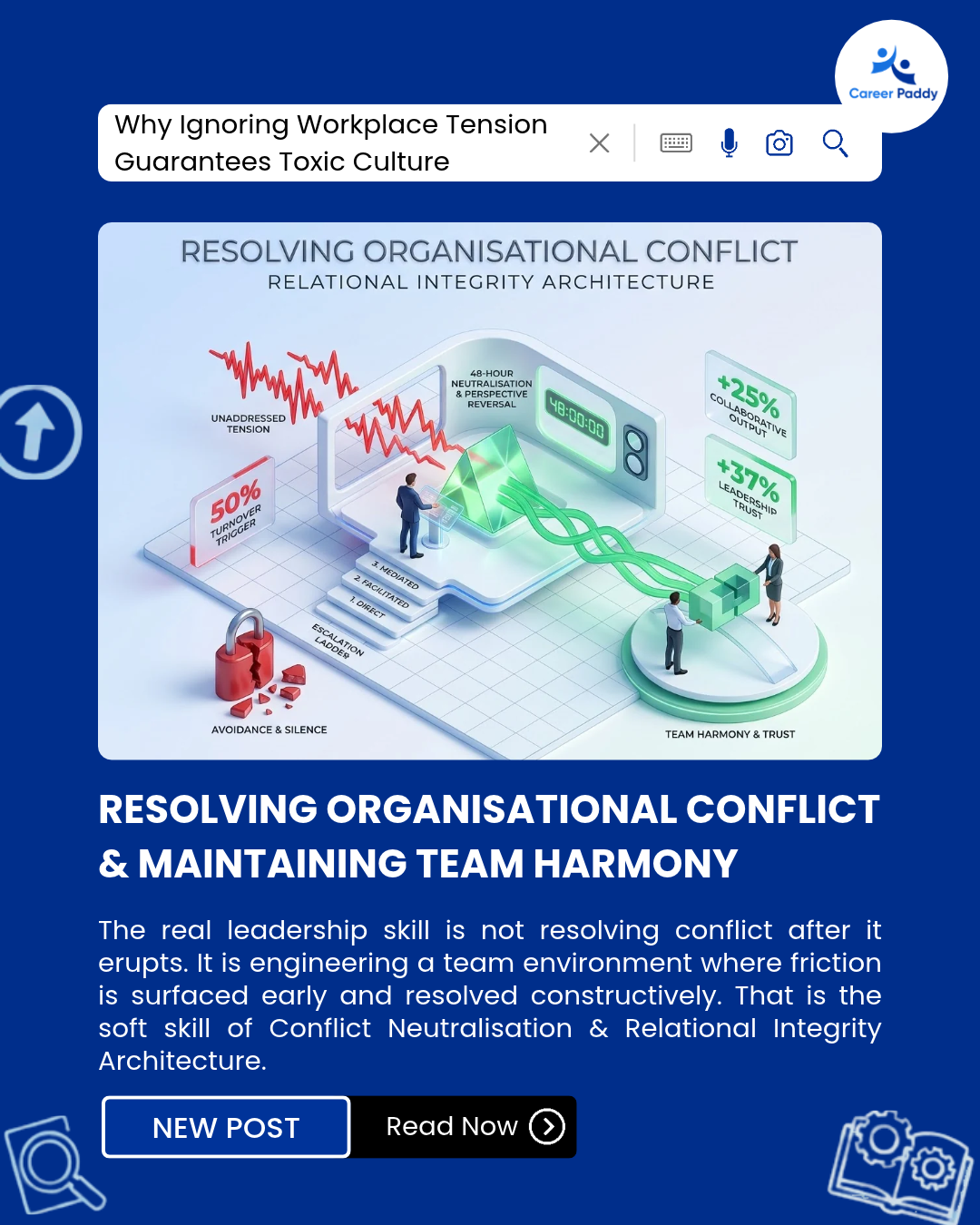
The real leadership skill is not resolving conflict after it erupts. It is engineering a team environment where friction is surfaced early and resolved constructively.
That is the soft skill of Conflict Neutralisation & Relational Integrity Architecture.
It is the discipline of detecting tension signals early, facilitating honest dialogue, and converting disagreements into stronger working relationships.
Why Resolving Conflict Matters
The Hidden Cost of Avoidance: Research from CPP Global (publishers of the Myers-Briggs Assessment) found that employees spend an average of 2.8 hours per week dealing with workplace conflict. That translates to approximately $359 billion in annual lost productivity across the United States alone.
The Turnover Trigger: According to SHRM (Society for Human Resource Management), unresolved workplace conflict is a primary driver behind 50% of voluntary employee departures. People do not leave bad companies. They leave unresolved toxic dynamics.
The Performance Rebound: Studies published by the Harvard Business Review show that teams where leaders address conflict constructively within 48 hours experience a 25% increase in collaborative output within the following quarter.
The Trust Restoration Effect: Research from the Center for Creative Leadership (CCL) demonstrates that leaders who facilitate direct conflict resolution are rated 37% higher in trust and credibility by their direct reports compared to leaders who avoid or suppress tension.
The Common Misconception
Many leaders believe that maintaining team harmony means keeping the peace at all costs.
They confuse harmony with silence. They mistake the absence of argument for the presence of alignment.
This is dangerous. When people stop disagreeing openly, they start disagreeing invisibly.
They withhold information. They sabotage timelines. They build underground coalitions against colleagues.
Genuine team harmony is not the absence of conflict. It is the presence of a safe, structured process for surfacing and resolving it.
Weak leaders avoid conflict entirely. Average managers suppress it with authority. Elite leaders channel it into stronger trust and sharper decisions.
How to Master Conflict Neutralisation & Relational Integrity Architecture
Intervene Within 48 Hours, Not 48 Days: The moment you detect friction between team members, address it privately and promptly. Conflict left unattended for more than two days begins forming emotional scar tissue that becomes exponentially harder to heal.
Use the Perspective Reversal Technique: Before letting either party state their complaint, ask each person to describe the situation from the other person’s point of view. This forces empathy before advocacy and immediately lowers defensive barriers.
Separate the Behaviour from the Person: Train yourself and your team to address specific actions, not character traits. Say “The report was submitted three days late, and that delayed the client response” instead of “You are unreliable.” Behavioural language invites correction. Character accusations invite war.
Establish a Conflict Escalation Protocol: Create a transparent, documented process that every team member knows. Step one is direct conversation between the parties. Step two is facilitated dialogue with the manager. Step three is mediation with HR or a neutral third party. When people know the system, they stop weaponising gossip.
Conduct Post-Resolution Check-Ins: Resolving a conflict once does not mean it stays resolved. Schedule a brief private follow-up with both parties within two weeks. Ask one question: “Is there anything still unresolved that we need to address?” This prevents recycled resentment from resurfacing months later.
Model Constructive Disagreement Publicly: Demonstrate healthy conflict in your own behaviour. Openly disagree with a peer in a meeting, explain your reasoning respectfully, and then visibly accept the final decision even if it goes against your position. Your team copies what you model, not what you preach.
In Summary
You will never build a healthy team culture by pretending conflict does not exist.
If your team has gone silent, that is not harmony. That is suppression waiting to detonate.
Stop hoping tension will resolve itself. Start building the systems and habits that convert friction into trust.
Because in executive leadership, your credibility is not measured by how many conflicts you avoid, but by how well you resolve the ones that matter.
You can visit CareerPaddy for more practical frameworks on conflict resolution and team culture leadership.
Access leadership modules on Conflict Resolution & Team Harmony on:
Career Paddy App on Play Store
Career Paddy App on Apple Store
Stay tuned for more career insights from CareerPaddy.
#Leadership #ConflictResolution #TeamHarmony #ExecutiveLeadership
