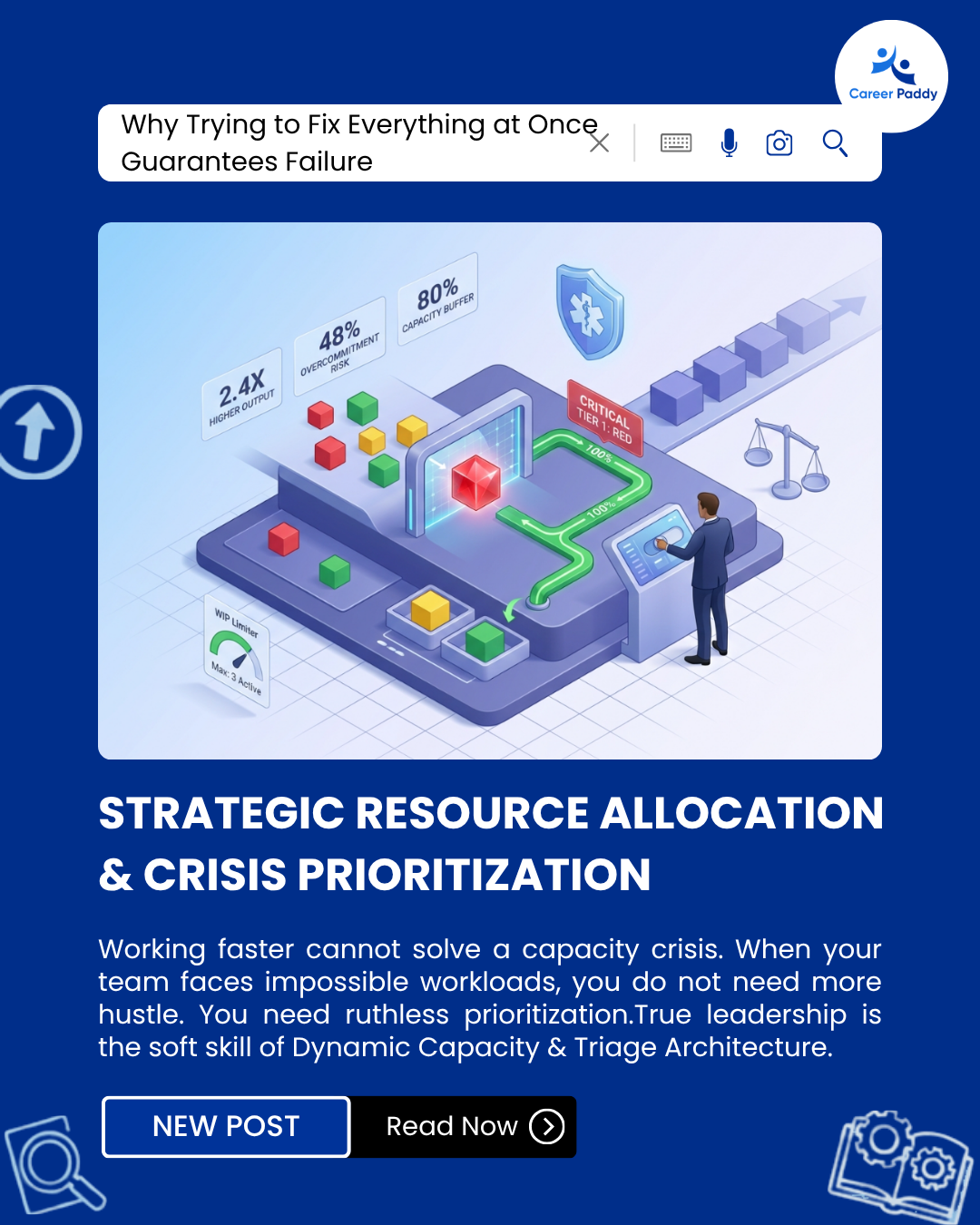
Why Trying to Fix Everything at Once Guarantees Failure
An emergency room was overflowing on a chaotic Friday night.
Patients packed the waiting area with sparained wrists, high fevers, and deep cuts. An inexperienced orderly rushed around in panic. He tried to treat every person in the exact order they arrived.
He spent twenty minutes wrapping a minor ankle sprain. Meanwhile, a patient in the back corner collapsed from sudden anaphylactic shock.
The floor was chaotic. Everyone was working at maximum speed, yet critical care was failing.
Then the head triage nurse took control of the floor.
She did not work faster. Instead, she stopped the chaos and categorized every patient immediately.
“Red tags go to trauma bay one right now,” she commanded. “Yellow tags wait in bay two. Green tags remain seated in the reception area.”
She moved 100% of the resuscitation equipment to the red-tag patient. Within five minutes, his airway was secured and his life was saved.
The Cost of False Urgency
The junior orderly did not lack compassion or hard work.
He failed because he treated every incoming problem with identical urgency.
In corporate management, overwhelmed team leads make this exact mistake every week.
When every client email, Slack message, and executive request is labeled an emergency, nothing is truly important.
Managers spread their team across twenty competing tasks. As a result, critical initiatives stall, deadlines collapse, and top performers burn out.
Working faster cannot solve a capacity crisis.
When your team faces impossible workloads, you do not need more hustle. You need ruthless prioritization.
True leadership is the soft skill of Dynamic Capacity & Triage Architecture.
It is the discipline of allocating scarce time, energy, and capital to the few moves that protect core business outcomes.
Why Resource Allocation Matters
The Burnout Predictor: Research from the Project Management Institute (PMI) reveals that 48% of project failures stem from poor resource allocation and chronic overcommitment. Unmanaged workloads are the leading cause of high-performer turnover.
The Productivity Paradox: Studies by Gartner show that teams focusing on three or fewer strategic priorities achieve 2.4x higher output than teams juggling seven or more initiatives. Ruthless focus directly accelerates delivery speed.
The Cognitive Drag: Research published in the Harvard Business Review demonstrates that task-switching and constant fire-fighting drain up to 40% of an employee’s productive mental capacity. Structural triage protects cognitive energy.
The Executive Filter: Over 89% of C-suite executives identify crisis decision-making and resource trade-offs as the primary differentiator between mid-level managers and executive leaders (McKinsey Quarterly).
The Common Misconception
Many team leads believe that saying “yes” to every stakeholder request demonstrates agility and commitment.
That is not commitment. That is operational surrender.
Saying yes to every new request is a silent decision to sabotage your existing commitments.
When you refuse to prioritize, you force your direct reports to guess what matters most.
Weak leaders accept every demand until their team breaks. Reactive leaders panic under pressure. Elite leaders make explicit trade-offs before crises erupt.
How to Master Dynamic Capacity & Triage Architecture
Apply the Clinical Triage Framework: Tag incoming projects into Red (immediate business risk), Yellow (important but stable), and Green (routine maintenance). Dedicate your best talent and immediate bandwidth exclusively to Red-tier priorities during crunch periods.
Establish Explicit Trade-Off Agreements: Never accept a new high-priority project without identifying what gets deprioritized. Ask stakeholders directly: “To deliver this new objective by Friday, should we pause Project Alpha or postpone Project Beta?”
Cap Work-In-Progress (WIP) Limits: Restrict the number of active projects each team member can handle at once to two or three. Forcing tasks to finish before new ones begin dramatically improves execution quality and cycle time.
Build Strategic Buffer Margins: Schedule team capacity at 80% rather than 100%. Maintaining a 20% operational reserve allows your team to absorb unexpected emergencies without crashing ongoing milestones.
Conduct Daily 10-Minute Blocker Standups: Replace lengthy status meetings with brief daily triage check-ins during high-pressure cycles. Focus entirely on identifying resource bottlenecks and reassigning overloaded tasks in real time.
Account for Emerging Market Volatility: In West African operational environments, power fluctuations, network downtime, and supply-chain delays are recurring realities. Build redundant communication channels and flexible deadlines into critical project timelines from day one.
In Summary
You cannot protect your team by working twelve-hour days.
When deadlines stack up and panic sets in, stop trying to do everything at once. Step back, evaluate the room, and tag the real emergencies.
Protect your people from false urgency and establish clear trade-offs with stakeholders.
Because in high-impact leadership, your success is measured not by how many tasks you start, but by the vital results you successfully finish.
You can visit CareerPaddy for more practical frameworks on resource management and career survival skills.
Access leadership modules on Strategic Resource Allocation & Decision-Making on:
Career Paddy App on Play Store
Career Paddy App on Apple Store
Stay tuned for more career insights from CareerPaddy.
#Leadership #Management #ResourceAllocation #Productivity #CareerGrowth #ProjectManagement #WorkplaceSuccess #CareerPaddy #TeamLeadership #CrisisManagement
