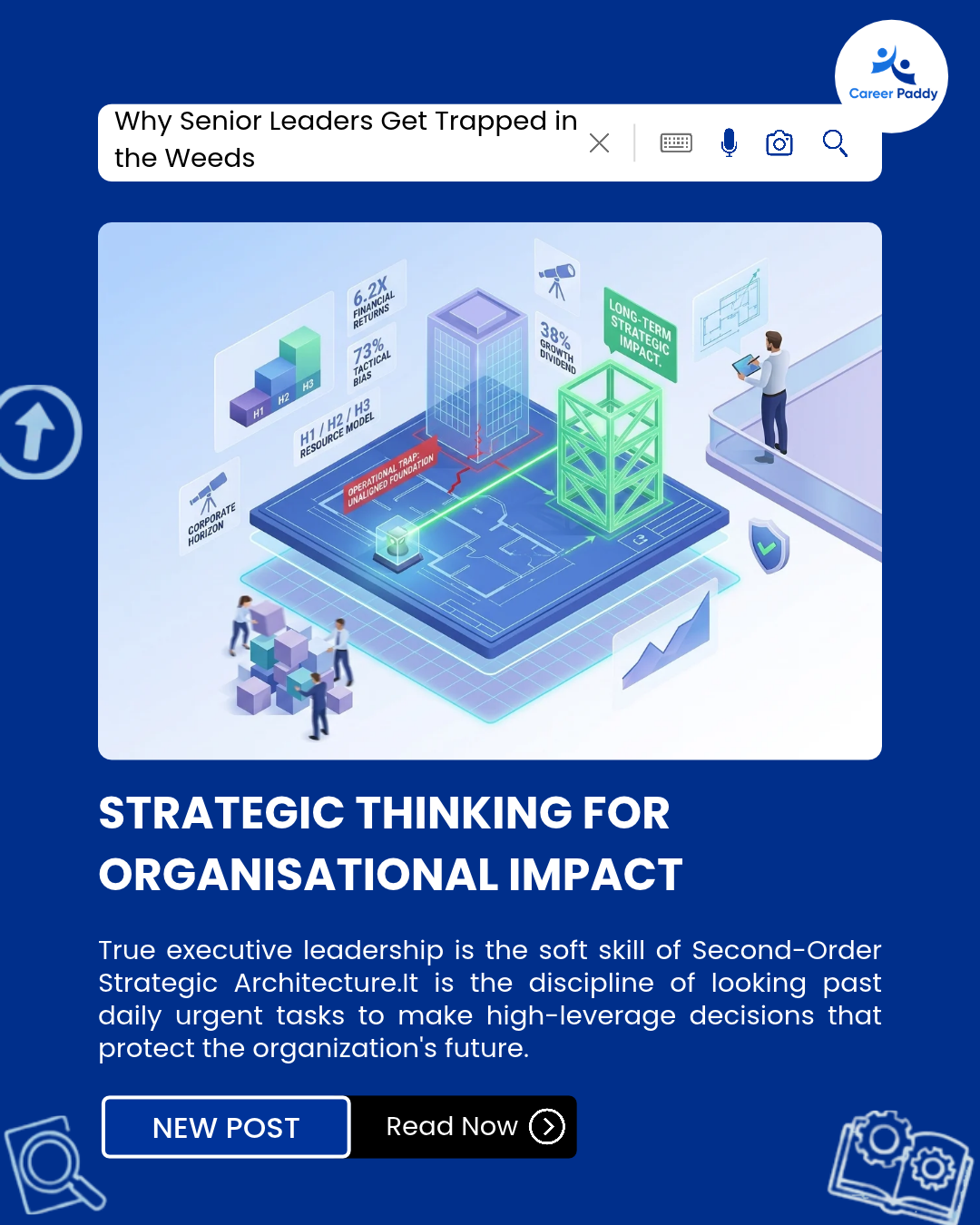
Why Senior Leaders Get Trapped in the Weeds and How to Drive Long-Term Impact
Two junior builders were constructing a three-story commercial complex.
They worked twelve hours a day under the hot sun, mixed cement, hauled heavy concrete blocks, and laid hundreds of bricks before dusk. They took pride in their exhausted muscles and dirty overalls.
On Friday morning, the chief structural architect arrived on site.
He did not pick up a shovel. He did not carry a single bag of cement.
Instead, he climbed the scaffolding, checked his laser transit level, and measured the soil grade. He spent two quiet hours analyzing the structural foundation.
The junior builders whispered among themselves. “Why is he just standing there while we do all the real work?”
Then the architect called an immediate halt to construction.
“The south corner has settled unevenly,” he told them. “The foundation is two inches out of alignment. If we lay another level of concrete, the entire third floor will crack and collapse next year.”
His two hours of quiet analysis saved the property developer eighteen months of reconstruction and millions of dollars in damages.
The Operational Trap of the Senior Executive
The junior builders were hardworking, energetic, and dedicated.
Yet their speed was almost catastrophic. They focused entirely on daily activity while ignoring structural alignment.
In corporate leadership, many senior managers fall into this exact operational trap.
They believe that leadership means attending fifteen meetings a day, answering 200 emails, and micromanaging daily tasks.
They confuse motion with progress and wear their exhaustion like a badge of honor.
When senior executives spend all their energy fighting daily operational fires, nobody is watching the horizon.
Competitors shift the market, customer demands evolve, and company resources drain into dying initiatives.
True executive leadership is the soft skill of Second-Order Strategic Architecture.
It is the discipline of looking past daily urgent tasks to make high-leverage decisions that protect the organization’s future.
Why Strategic Thinking Matters
The Strategic Performance Gap: Research from the Harvard Business Review reveals that leaders who dedicate at least four hours a week to long-term strategic planning are 6.2x more likely to deliver top-quartile financial returns.
The Executive Failure Mode: Studies published by McKinsey & Company show that 73% of corporate executives admit their leadership teams spend too much time on short-term tactical issues instead of strategic positioning.
The Organizational Alignment Dividend: According to research from MIT Sloan Management Review, companies with clear, cross-functional strategic clarity achieve 38% faster revenue growth and 2.1x higher employee retention.
The Boardroom Requirement: Over 92% of corporate boards cite strategic judgment and second-order thinking as the primary criterion for CEO and C-suite succession (PwC Executive Survey).
The Common Misconception
Many managers believe that strategic thinking is a vague academic exercise reserved for annual corporate retreats.
They view strategy as a thick slide deck full of buzzwords that sits unread on a server.
That is corporate theater, not strategy.
Real strategic thinking is deeply practical. It is the active discipline of deciding what your organization will not do.
Strategy is choosing which good opportunities to reject so that your team can dominate its most vital objectives.
Weak leaders react to whatever problem shouts loudest. Average managers execute tasks efficiently. Elite executives position their organizations to win before the fight begins.
How to Master Second-Order Strategic Architecture
Schedule Uncompromised Strategy Blocks: Block out two ninety-minute windows on your calendar each week for deep strategic analysis. Protect this time fiercely from routine operational emails, administrative requests, and impromptu meetings.
Apply Second-Order Thinking to Key Decisions: Before approving any major project or policy change, ask your team: “And then what happens?” Evaluating the third- and fourth-degree consequences of today’s choices prevents expensive long-term mistakes.
Deploy the Horizon 1-2-3 Resource Model: Divide your department’s budget and human capital intentionally. Allocate 70% of bandwidth to core daily operations (H1), 20% to emerging growth bets (H2), and 10% to transformative future initiatives (H3).
Identify High-Leverage Strategic Constraints: Stop trying to solve twenty organizational issues simultaneously. Use the Theory of Constraints to locate the single operational bottleneck holding back company performance and concentrate executive resources there.
Build Cross-Functional Alignment Bridges: Connect your department’s daily metrics directly to top-level organizational goals. When every team member understands how their work drives the corporate mission, execution speed increases naturally.
Account for Macroeconomic Shifts in Emerging Markets: In African business ecosystems, currency volatility, regulatory updates, and supply chain disruptions require agile strategic contingencies. Build flexible operating models and diversified cash flow buffers into your multi-year strategy.
In Summary
Working yourself into exhaustion will not build a sustainable business.
If you spend all your time laying bricks, no one will notice when the foundation starts sinking.
Step off the operational treadmill. Look at the structural horizon, evaluate the real constraints, and set a clear direction for your people.
Because in senior leadership, your value is determined not by how fast you run, but by where your vision leads the entire organization.
You can visit CareerPaddy for more practical frameworks on executive leadership and corporate survival skills.
Access executive courses on Strategic Thinking & Organizational Leadership on:
Career Paddy App on Play Store
Career Paddy App on Apple Store
Stay tuned for more career insights from CareerPaddy.
#Leadership #StrategicThinking #ExecutiveLeadership #Management #CareerGrowth #BusinessStrategy #WorkplaceSuccess #CareerPaddy #Strategy #Productivity
