Why Drowning in “Sand” is Silently Killing Your Career Growth
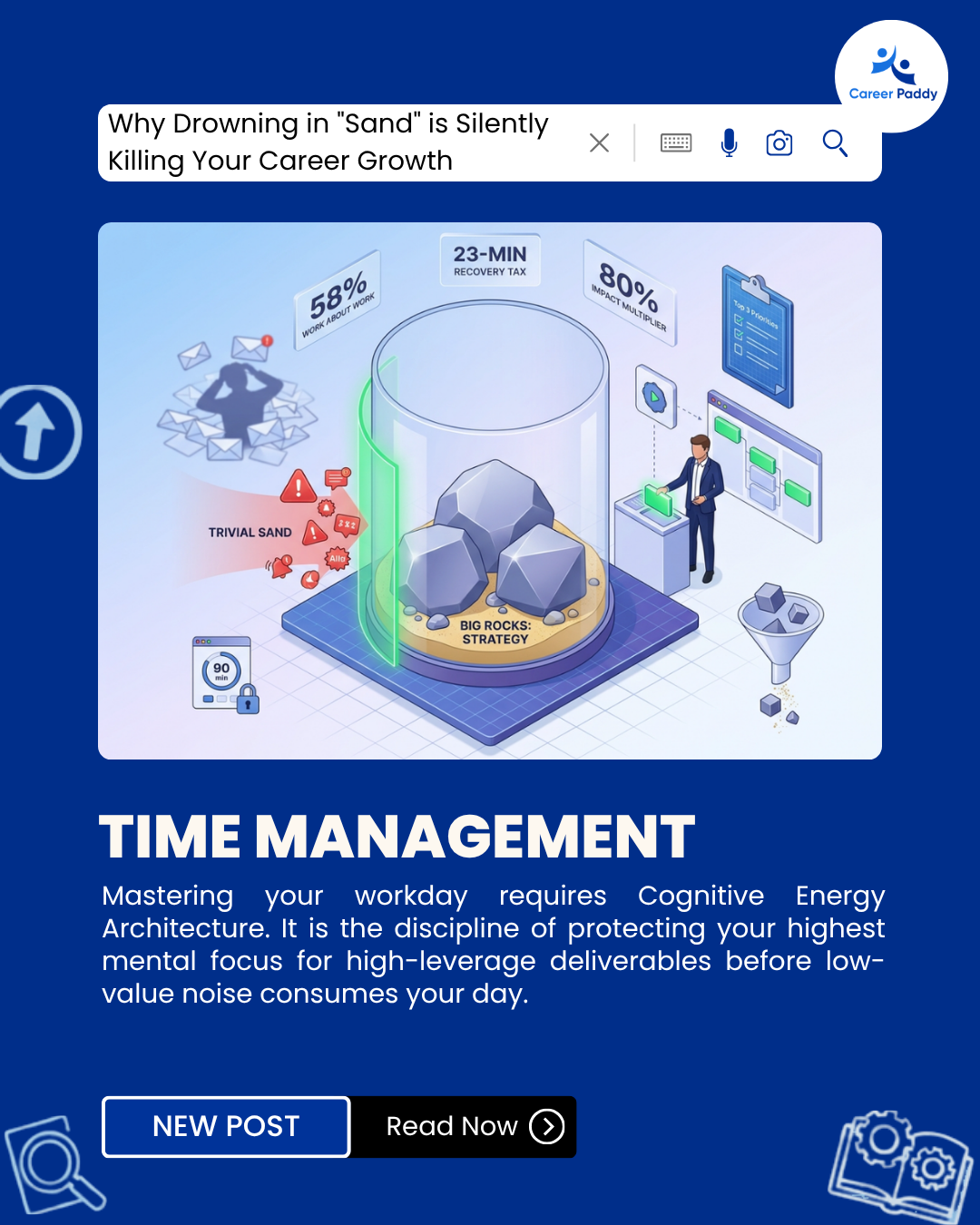
A professor once stood before his class with a large glass jar. Beside him sat a pile of fist-sized rocks, a bucket of small pebbles, and a bag of fine sand.
He filled the jar with the large rocks first. He asked his students if the jar was full. They all answered yes.
The professor then poured in the pebbles. They rattled down into the open spaces between the large rocks.
Finally, he poured in the sand. The tiny grains settled into every remaining crevice, filling the jar completely.
The Trap of Fake Busywork
The professor looked at his students and shared a vital rule.
If you put the sand in first, there is zero room for the large rocks.
In the corporate world, most early-career professionals live in reverse.
They spend their mornings drowning in sand by answering routine emails immediately, responding to instant messages within seconds. They attend low-value status meetings.
By mid-afternoon, their cognitive energy is completely drained. Their big rocks the strategic projects that actually drive business value remain untouched.
Being busy is not the same as being effective. Motion is not progress.
Drowning in trivial tasks creates an illusion of high performance. But leadership judges you on strategic output, not task volume.
Mastering your workday requires Cognitive Energy Architecture. It is the discipline of protecting your highest mental focus for high-leverage deliverables before low-value noise consumes your day.
Why Task Prioritization Matters
The Fake Work Tax: Research from the Asana Anatomy of Work Index reveals that knowledge workers spend 58% of their workday on “work about work.” Routine coordination and status updates crowd out meaningful execution.
The Focus Recovery Cost: Studies from the University of California, Irvine show that it takes 23 minutes to regain deep focus after a single minor distraction. Constant message-checking destroys productivity.
The Leverage Multiplier: Research in the Harvard Business Review demonstrates that prioritizing the top 20% of high-impact tasks generates 80% of project value. Focusing on big rocks accelerates project delivery.
The Promotion Differentiator: Over 84% of executives rate prioritization and focus as top indicators of leadership potential (NACE Career Readiness Framework). Leaders promote professionals who manage their time with intent.
The Common Misconception
Many believe that high productivity means clearing every item on their daily to-do list.
That belief keeps professionals trapped on a treadmill of reactive work.
When you treat every incoming message as an emergency, you lose control of your schedule. You end up working late nights just to finish your actual core tasks.
True productivity is about Ruthless Exclusion.
It means deciding what not to do today. It means leaving non-critical messages unanswered for two hours so you can complete a major report.
Busyness is reactive. Prioritization is intentional.
How to Master Cognitive Energy Architecture
Define Your Three Big Rocks Daily: Before checking email in the morning, write down your top three needle-moving tasks. Commit to finishing these core deliverables before opening routine communication channels. Starting with your big rocks guarantees meaningful daily progress.
Build a 90-Minute Focus Fortress: Block the first 90 minutes of your morning for uninterrupted deep execution. Silence all non-essential notifications and close chat tabs during this window. Protecting your morning focus yields your highest quality output.
Batch the Sand into Set Windows: Stop answering emails and Slack pings continuously throughout the day. Set two dedicated 30-minute windows such as 11:30 AM and 4:30 PM to clear incoming messages. Batching administrative tasks protects your attention from constant fragmentation.
Negotiate Trade-Offs Proactively: When a manager assigns an urgent new task to an already full schedule, do not simply say yes and drown. Ask calmly: “I am currently executing Project A and Project B today. Which one should I pause to prioritize this new request?” This demonstrates professional composure and manages expectations cleanly.
Audit Your Weekly Time Leaks: Spend fifteen minutes every Friday reviewing your calendar and task log. Identify meetings where your presence added zero value and cancel recurring low-impact appointments. Cutting low-value commitments preserves hours for strategic work.
Buffer for Local Infrastructure Friction: In the West African corporate environment, power drops and network delays are routine operational risks. Never schedule critical work right against a hard deadline. Build a two-hour buffer into major submissions to absorb sudden unexpected interruptions.
In Summary
You can work twelve hours a day and still make zero meaningful progress in your career.
If your schedule is filled with sand, your big rocks will always be pushed aside. You will remain exhausted, overwhelmed, and overlooked for advancement.
Take sovereignty over your calendar. Put your big rocks in first, batch the sand, and protect your focus with discipline.
In a distracted world, the professional who controls their focus controls their career trajectory.
You can visit CareerPaddy for more practical resources on workplace productivity and survival skills.
Access survival courses on Time Management & Prioritization on:
Career Paddy App on Play Store
Career Paddy App on Apple Store
Stay tuned for more career insights from CareerPaddy.
#SoftSkills #SurvivalSkills #CareerGrowth #WorkplaceSuccess #CareerPaddy #CareerTips #TimeManagement #Productivity #DeepWork #Focus
