Why Analysis Paralysis Destroys Organizations and How Elite Leaders Decide Under Ambiguity
A mountain climbing team was hiking a steep alpine ridge when freezing fog suddenly rolled in.
The temperature plummeted. Daylight was fading rapidly, and the trail ahead disappeared into the mist.
The junior guide panicked. He pulled out three weather meters, opened two navigation apps, and tried to connect to a satellite forecast. He wanted complete certainty before choosing between climbing to the summit cabin or retreating to the emergency shelter cave.
He spent forty-five minutes analyzing conflicting sensor readings while the team stood shivering in the biting wind.
The veteran lead guide stepped forward and halted the analysis.
“We do not have perfect data, and we cannot afford to wait for it,” she told him calmly. “The wind angle and the dropping barometric pressure give us seventy percent certainty. We move to the shelter cave right now.”
She ordered the team to turn back immediately. They reached the shelter cave fifteen minutes before a violent blizzard slammed into the mountain.
Had they waited for the satellite forecast to load, the entire team would have suffered severe hypothermia on the exposed ridge.
The Lethal Cost of Analysis Paralysis
The junior guide did not lack intelligence or technical skill.
He failed because he believed that good leadership requires absolute certainty before taking action.
In corporate leadership, average executives make this fatal mistake every single quarter.
When facing complex market shifts, operational disruptions, or high-stakes business choices, they delay decisions endlessly.
They request another round of reports, schedule six more committee meetings, and commission expensive consulting studies.
They believe they are mitigating risk. In reality, they are letting the market make the decision for them.
By the time you have 100% of the information, the opportunity is dead, competitors have moved, and your team is exhausted.
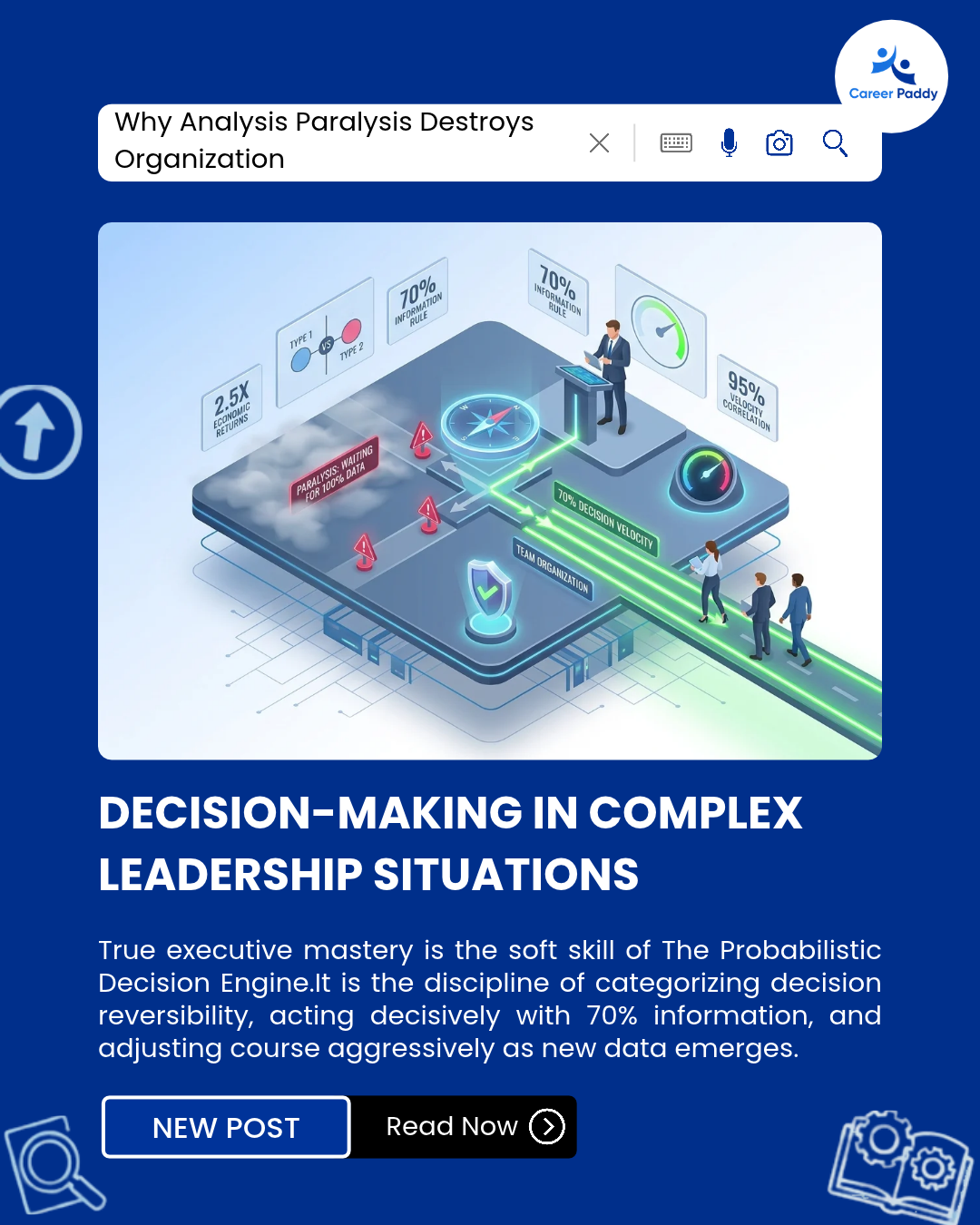
True executive mastery is the soft skill of The Probabilistic Decision Engine.
It is the discipline of categorizing decision reversibility, acting decisively with 70% information, and adjusting course aggressively as new data emerges.
Why Decision Velocity Matters
The High-Performer Differentiator: Research from McKinsey & Company shows that organizations with fast, high-quality decision-making processes deliver 2.5x higher economic returns and 20% higher return on invested capital than slow competitors.
The Paralysis Penalty: Studies published in the Harvard Business Review reveal that excessive consensus-seeking and analysis paralysis destroy up to 50% of potential project value before execution even begins.
The Execution Dividend: According to research from Bain & Company, decision effectiveness and velocity correlate at over 95% with overall corporate financial performance and operational agility.
The C-Suite Benchmark: Over 88% of corporate board directors rank executive decision-making under ambiguity as the single most critical leadership competency for modern enterprise leaders (Gartner Leadership Insights).
The Common Misconception
Many senior leaders believe that delaying a hard decision is a neutral, safe stance until more data arrives.
That is not safety. That is operational decay.
When you refuse to decide, you freeze capital, stall project timelines, and trap your direct reports in limbo.
Waiting for complete certainty does not eliminate risk; it simply trades visible decision risk for silent organizational failure.
Weak leaders freeze in ambiguity. Bureaucratic managers hide behind endless data. Elite executives assess odds, decide with conviction, and steer through uncertainty.
How to Master The Probabilistic Decision Engine
Separate Type 1 and Type 2 Decisions: Classify choices into irreversible “one-way doors” (Type 1) and easily reversible “two-way doors” (Type 2). Make Type 2 decisions within hours, and reserve deep analytical rigor exclusively for high-stakes, irreversible moves.
Apply the 70% Information Rule: Make your call when you have approximately 70% of the information you wish you had. Waiting for 90% or more ensures that your organization moves too slowly to capitalize on strategic windows.
Conduct a Structured Project Premortem: Before finalizing a major decision, ask your executive team: “Imagine we are twelve months in the future and this initiative has failed catastrophically. What caused the collapse?” Surfacing hidden vulnerabilities early prevents blind spots.
Establish Explicit Decision Ownership: Eliminate committee ambiguity by appointing a single Designated Decision Maker for every major strategic choice. Gathering broad team input is essential, but ultimate accountability must rest with one individual.
Define Tripwire Triggers in Advance: Set objective quantitative metrics that will trigger an immediate pivot if early assumptions prove incorrect. Pre-established tripwires remove emotional attachment and allow teams to course-correct without shame.
Account for Emerging Market Volatility: In African corporate environments, currency devaluations, policy updates, and infrastructure challenges require agile decision frameworks. Build scenario-based contingency triggers into your execution plans rather than relying on rigid, single-track forecasts.
In Summary
You will never have all the data you want before making a high-stakes leadership call.
When ambiguity surrounds your organization, stop hiding behind spreadsheets and endless review cycles.
Classify the reversibility, assess the odds, and make the call with conviction.
Because in executive leadership, speed of decision and clarity of direction will always outperform delayed perfection.
You can visit CareerPaddy for more practical frameworks on executive leadership and decision survival skills.
Access executive courses on Decision-Making Under Ambiguity & Strategic Leadership on:
Career Paddy App on Play Store
Career Paddy App on Apple Store
Stay tuned for more career insights from CareerPaddy.
#Leadership #DecisionMaking #ExecutiveLeadership #Management #CareerGrowth #BusinessStrategy #WorkplaceSuccess #CareerPaddy #Strategy #Productivity
