Why is Silence in Small Meetings a Career Liability?
In entry-level roles, professionals often default to silence during team syncs, departmental meetings, or small group discussions. There is a common comfort in believing that staying quiet shows humility, respect for seniority, or that your “hard work will speak for itself.” This is an expensive misconception. In the modern workspace, if you are silent, you are invisible
Small Group Communication is not about performative talking or dominating the room; it is the soft skill of Strategic Presence. It is the ability to articulate clear, constructive points that move a small team decision forward. In a highly competitive market, speaking with measured confidence in small groups is how you signal leadership potential before you ever hold a title.
Why Small Group Confidence Matters
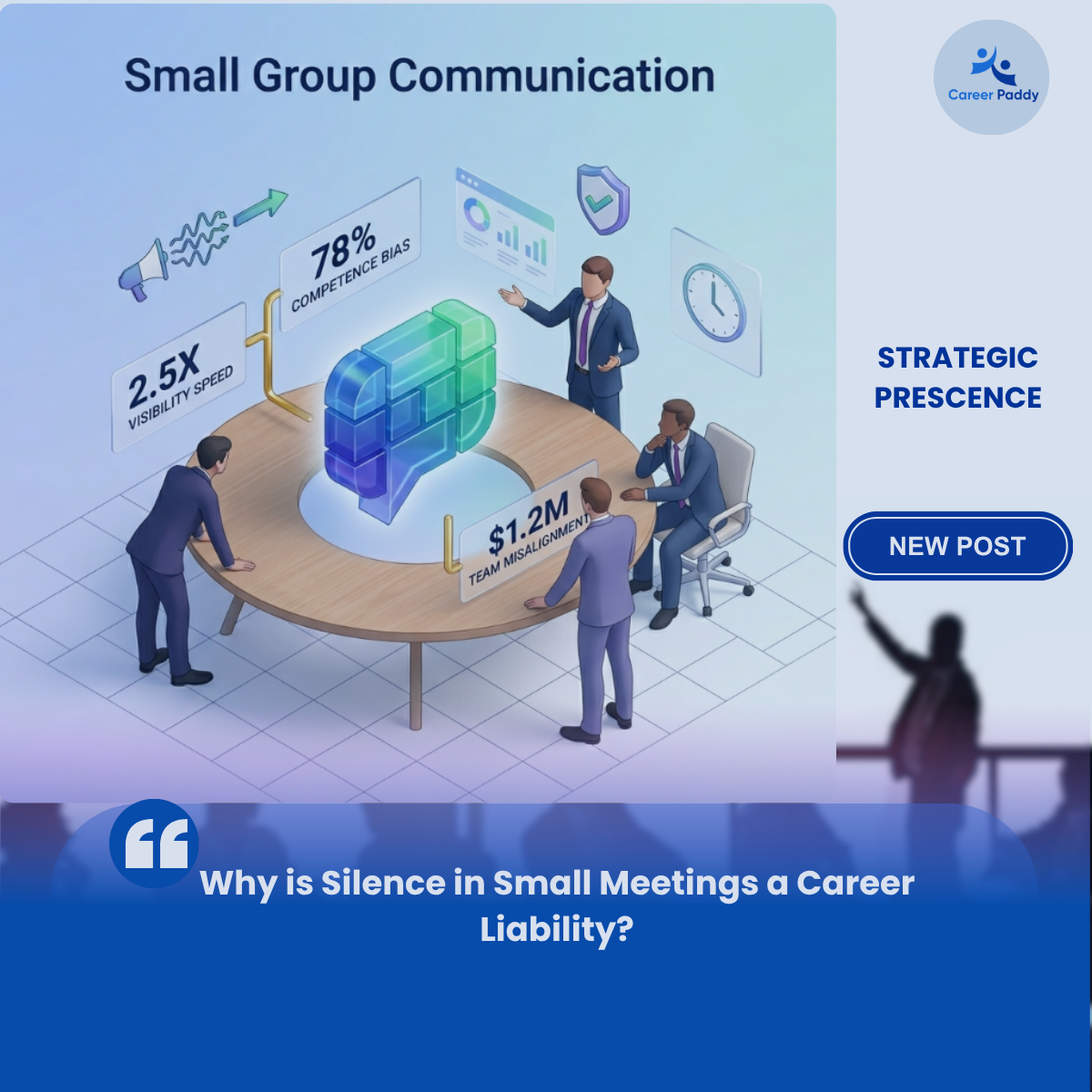
- The Visibility Premium: Professionals who actively contribute at least one constructive point in small group meetings are 2.5x more likely to be considered for high-visibility projects by senior management (LinkedIn Workplace Learning Report, 2025).
- The Promotion Multiplier: A survey of corporate managers revealed that 78% associate a junior employee’s verbal confidence in meetings with high competence, making it a primary informal metric for promotion speed (Forbes Advisor, 2024).
- Team Alignment Efficiency: Misaligned team objectives from poorly coordinated small meetings cost mid-market enterprises an average of $1.2 million annually in wasted hours and duplicate efforts (Gartner Digital Workplace Research, 2026).
- The Collaboration Shortage: 68% of team leads cite “passive participation” in small syncs as the single biggest bottleneck to rapid project execution and problem-solving (World Economic Forum, 2025).
- Psychological Safety & Output: Teams where entry-level members speak up confidently experience a 22% increase in project innovation output because flaws are caught before implementation (Harvard Business Review, 2025).
Common Misconception
The misconception is that speaking with confidence requires being an extrovert, a charismatic orator, or the smartest person in the room. This fear keeps people silent. True small-group confidence is structural, not emotional. It is about using simple frameworks to deliver high-density information clearly. You do not need to speak long; you just need to speak accurately.
How to Speak with Confidence in Small Groups
- Deploy the “PREP” Framework: Structure your points instantly using Point, Reason, Example, Point. State your Point (“We should automate this tracker”), give your Reason (“It saves three hours weekly”), provide an Example (“Team B did this last month”), and restate your Point (“So, automation is our best path”).
- Anchor Your Entry: Do not wait for a perfect pause; they rarely exist. Use standard anchor phrases to enter the conversation cleanly, such as: “Building on that point,” or “Looking at the data from a different angle…”
- Own Your Airtime: Speak at a deliberate, measured pace. Early-career professionals often rush their words out of anxiety, which diminishes perceived authority. Slowing down signals emotional regulation and confidence.
- Use the “One-Point” Goal: Never sit through a meeting without contributing. Set a personal rule to speak exactly once in the first 15 minutes, whether it is asking a sharp clarifying question or validating a strategy with a metric.
- Separate the Idea from Your Ego: If someone challenges your suggestion, do not take it as a personal attack. Reframe it immediately: they are testing the logic of the idea, not your value as a professional.
- Eliminate Filler Diminishers: Ruthlessly strip words like “Just,” “Sorry,” or “I might be wrong but…” from your vocabulary. Instead of saying, “I just wanted to quickly say,” say, “My recommendation is…”
In Summary
Small meetings are the real arena where professional reputations are built or lost. Your hard work behind a laptop sets your baseline, but your voice in the room determines your trajectory.
In a corporate environment that demands rapid execution, clarity and structural confidence are rare currencies. By mastering the art of small group communication, you step out of the shadows of passive execution and position yourself as a strategic thinker. Stop letting your silence be misread as a lack of capability.
You can visit CareerPaddy for more information that can guide you through your career.
You can also access survival skills courses on Strategic Prescence on
Stay tuned for more analysis from CareerPaddy
#SoftSkills #SurvivalSkills #CareerGrowth #WorkplaceSuccess #CareerPaddy #CareerTips #Communication #Confidence #PublicSpeakingc
