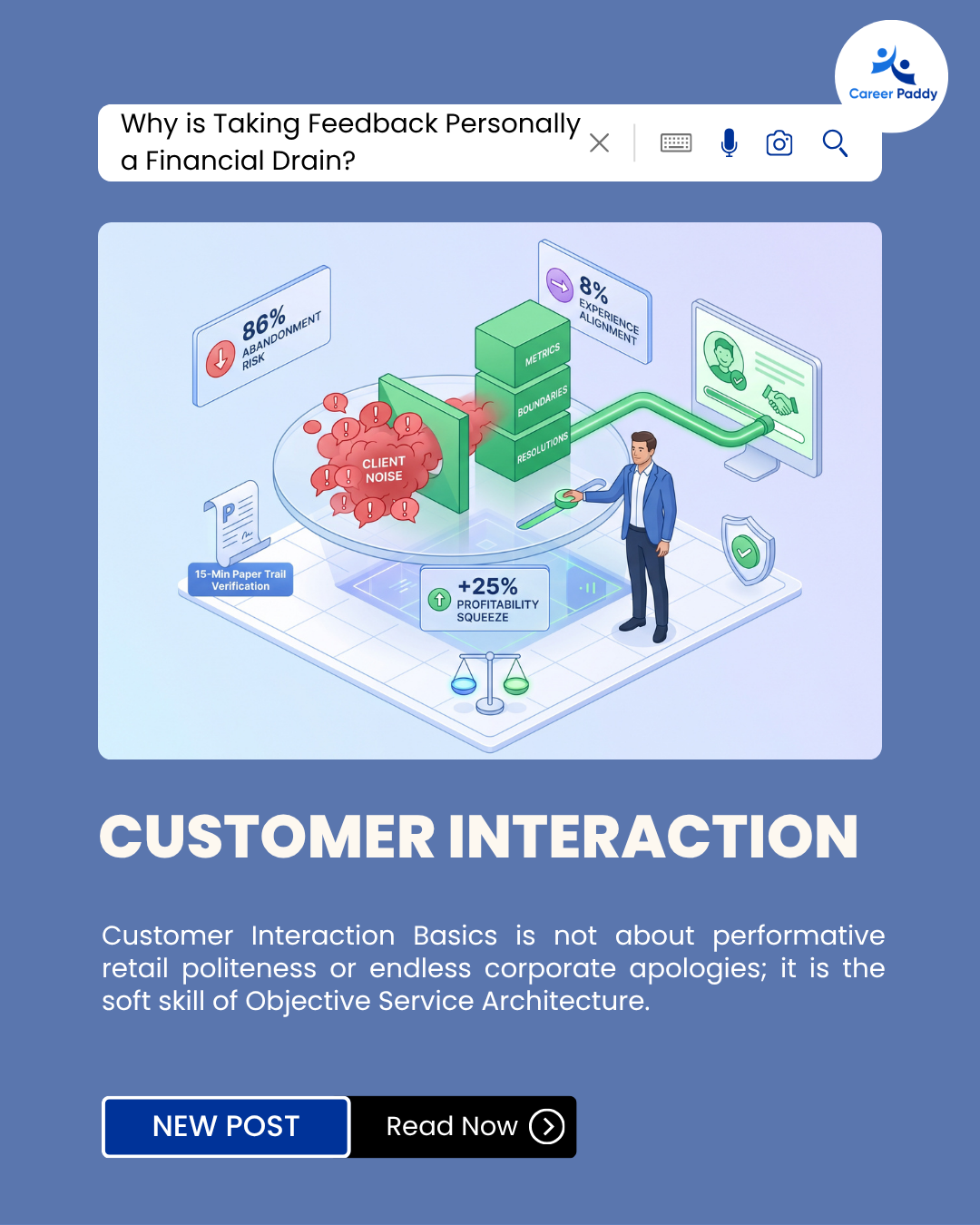
Why is Taking Feedback Personally a Financial Drain?
In entry-level roles, young professionals often treat client or stakeholder interactions as personal battles. When a customer flags a flaw, critiques a layout design, or demands an urgent modification, the immediate reaction is to become defensive, argue, or delay communication out of sheer frustration. This adversarial mindset is a catastrophic career bottleneck. In a corporate execution loop, a client is not an opponent to defeat; they are an entity paying for a specific operational outcome.
Customer Interaction Basics is not about performative retail politeness or endless corporate apologies; it is the soft skill of Objective Service Architecture. It is the systematic ability to decouple a client’s emotional frustration from their actual business requirements, ensuring you resolve the bottleneck without burning out your own cognitive bandwidth. In 2026, where retention is the absolute highest priority for local businesses, a professional who can smoothly de-risk a chaotic customer account is an indispensable asset.
Why Client Management Matters
- The Retention Premium: Resolving a service issue efficiently directly impacts the bottom line, as increasing customer retention metrics by just 5% surges overall profitability by up to 25% to 95% (Harvard Business Review Analytics).
- The Cost of Friction: A staggering 86% of corporate buyers will entirely abandon a service provider or brand after experiencing just two instances of poor, uncooperative, or defensive customer communication (PwC Global Consumer Insights).
- The Valuation Gap: While 80% of entry-level staff believe they provide a premium, collaborative client experience, only a brutal 8% of clients agree, highlighting a massive delivery disconnect (Bain & Company Delivery Study).
- The Growth Multiplier: Organizations that prioritize the NACE Customer Service Core Competency experience a 4-8% revenue expansion over their direct market competitors by locking down client renewals early.
- The Acceleration Factor: Junior talent who can de-escalate high-friction client calls independently are moved out of basic production loops and into premium account management roles 3x faster.
Common Misconception
The misconception is that good customer interaction means saying “yes” to every single chaotic, un-scoped client demand. This boundary-less approach results in intense scope creep, missed timelines, and ultimate project failure. True customer management is about Clear Alignment. It means establishing firm, transparent boundaries, managing expectations aggressively from Day 1, and translating messy, emotional complaints into precise technical deliverables.
How to Master Objective Service Architecture
- Deploy the “HEAL” Framework: When a client launches an aggressive complaint, execute four mechanical steps: Hear (let them vent for 60 seconds without interrupting), Empathize (acknowledge the workflow disruption), Analyze (strip out the insults and isolate the core asset failure), and Lead (present an immediate, data-backed resolution timeline).
- Translate Vague Criticisms into Metrics: Never accept a subjective feedback tag like “This doesn’t pop” or “It looks a bit off.” Reframe it immediately: “To ensure we match your exact brand alignment, are we looking to increase the visual contrast of the primary call-to-action button, or should we adjust the structural grid layout?”
- Enforce the “Paper Trail” Rule: Never conclude a phone conversation or a quick video sync without documenting the outcomes. Send a concise, bulleted summary within 15 minutes: “Per our call, I will modify the asset dimensions to 1080×1080 and deliver the finalized rendering by 3:00 PM today.” This prevents historical revisionism.
- Isolate the Ego from the Feedback: When a client yells or writes in capital letters, remind yourself that they are reacting to a threat to their business metrics or budget, not your character. Keep your verbal inflection completely flat and focused strictly on the resolution path.
- Manage Local Delays Proactively: In the West African market, sudden infrastructure drops are a reality. If a power cut or network failure is going to delay a client deliverable, do not wait for the deadline to pass. Notify them 2 hours in advance: “We are adjusting our deployment window by 45 minutes due to an explicit server sync delay. We are tracking the process closely.”
- Strip Out Defensive Language: Erase phrases like “That wasn’t part of the brief” or “You didn’t specify that earlier.” Shift to proactive, high-trust wording: “To integrate this new parameter seamlessly without disrupting our launch target, we can execute it as a secondary iteration immediately following today’s core delivery.”
In Summary
Your technical execution can be entirely flawless, but if you are combative, defensive, and difficult for clients to interact with, you remain a high-risk liability to your organization.
By shifting from emotional reactivity to systematic service architecture, you take sovereignty over your professional relationships. You stop being a reactive task-worker and become a trusted solution partner. Manage the alignment, protect the parameters, and let your seamless delivery dictate your market value.
You can visit CareerPaddy for more information that can guide you through your career.
You can also access survival skills courses on Objective Service Architecture. on
Stay tuned for more analysis from CareerPaddy
#SoftSkills #SurvivalSkills #CareerGrowth #WorkplaceSuccess #CareerPaddy #CareerTips #CustomerService #ClientManagement #Alignment #Professionalism
