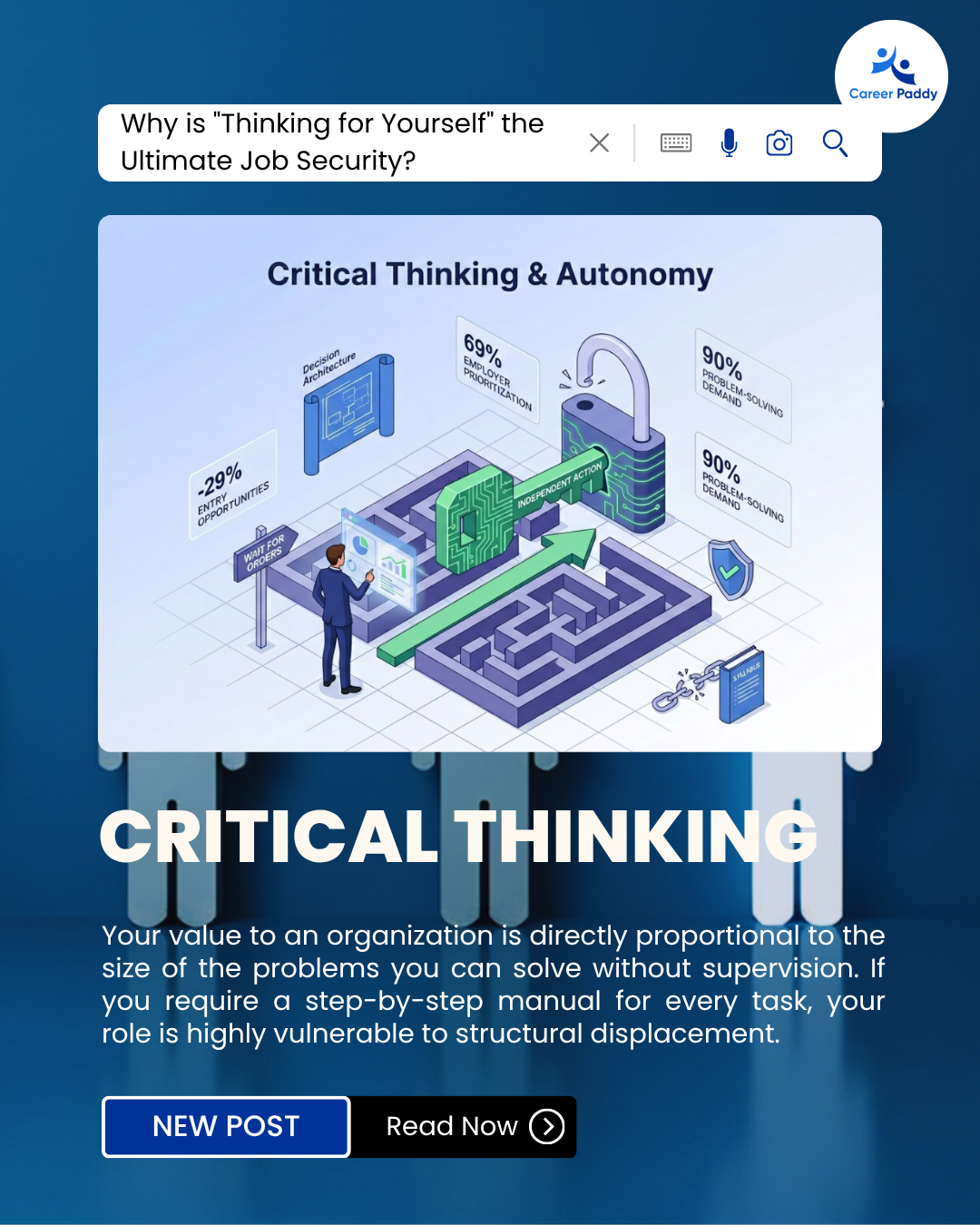
Why is “Thinking for Yourself” the Ultimate Job Security?
In entry-level roles, the instinct is to treat every minor ambiguity as a roadblock requiring a manager’s intervention. You wait for an email, a meeting, or a direct order before acting. This behavior is a relic of the academic system, where you are rewarded for following a syllabus. In the 2026 corporate workspace, this “wait-and-see” approach is a liability. It creates bottlenecks and signals to leadership that you are a task-taker, not a problem-solver.
Critical Thinking is the survival skill of Independent Decision Architecture. It is the ability to deconstruct a problem, evaluate the available data, and propose a viable solution before escalating it to your superior.
Why Independent Thought Matters
- The Execution Disconnect: A stark 90% of employers rate problem-solving as a must-have capability, yet managers consistently cite independent task execution as a massive competency gap in incoming graduates (NACE Job Outlook Data Overview).
- The Automation Squeeze: Traditional entry-level roles focused on rote tasks have seen structural shrinkage, with overall employer GPA-screening filters plunging to an all-time low of 42% as the market pivots strictly to skills-based evaluation metrics (NACE Talent Acquisition Survey Data).
- The Autonomy Premium: Forward-thinking organizations are bypassing traditional degree metrics, as 70% of hiring teams prioritize candidate performance on practical, situational assessment frameworks during the hiring lifecycle (NACE Workplace Hiring Metrics).
- The Acceleration Factor: Early-career workers who move beyond simple task execution and actively practice the NACE Critical Thinking Core Competency bypass routine management cycles and enter leadership tracks substantially faster.
- The Core Priority: Independent logical analysis remains an irreplaceable human asset, with global talent leaders ranking it above domain expertise when staffing complex, fast-moving corporate operational pods.
Common Misconception
The misconception is that taking initiative means making reckless, high-risk executive decisions without alignment. This fear of overstepping bounds is what paralyzes junior staff into total passivity. Independent decision architecture is not about rogue authority; it is about Strategic Proactiveness. It means doing the diagnostic lifting before you speak to your manager, so you bring them solutions to validate instead of messy puzzles to solve.
How to Build Independent Decision Architecture
- Enforce the “Bring a Solution” Mandate: Never present a problem to your manager without attaching at least one clear recommendation. Instead of asking, “The client rejected the layout, what should I do?”, say: “The client rejected the layout. I have analyzed their feedback and sketched two alternative adjustments. I recommend Option A because it preserves our timeline.”
- Isolate the True Scope of Ambiguity: When an assignment lacks specific instructions, do not stall. Identify exactly what data is missing, make a logical, documented assumption to bridge the gap, and proceed with your execution while flagging your choice clearly in your status update.
- Execute a Local Constraint Pre-Check: Build a personal risk mitigation protocol so your output remains consistent despite external variables.
- Audit the Logical Source Material: Stop relying on second-hand office summaries or chat interpretations. Go directly to the foundational source documents, the raw brief, the initial email chain, or the core system analytics, to construct your operational conclusion.
- Utilize “If-Then” Boundary Testing: Map out your execution paths before seeking sign-off. Define: “If the client approves the direction by 2:00 PM, I will initiate the rendering. If they delay, I will pivot to formatting the secondary asset pool to protect our target delivery.”
In Summary
Your value to an organization is directly proportional to the size of the problems you can solve without supervision. If you require a step-by-step manual for every task, your role is highly vulnerable to structural displacement.
By shifting from an academic syllabus mindset to a framework of total career sovereignty, you change how leadership perceives your capability. You stop waiting for orders and start driving outcomes. Think for yourself, de-risk your execution, and let your independent throughput dictate your career velocity.
You can visit CareerPaddy for more information that can guide you through your career.
You can also access survival skills courses on Critical thinking on
Stay tuned for more analysis from CareerPaddy
#SoftSkills #SurvivalSkills #CareerGrowth #WorkplaceSuccess #CareerPaddy #CareerTips #CriticalThinking #ProblemSolving #Autonomy #OwnershipMindset
