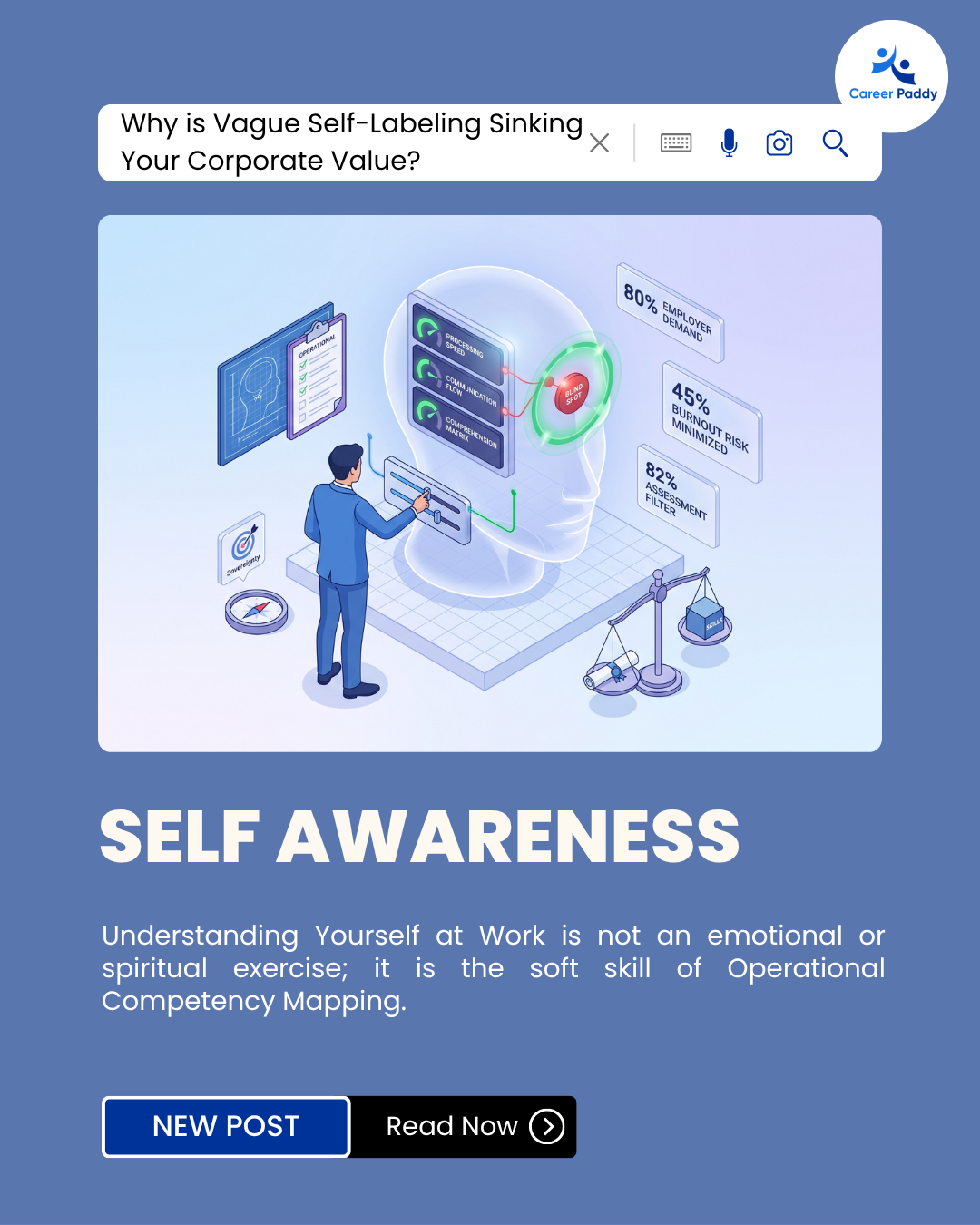
Why is Vague Self-Labeling Sinking Your Corporate Value?
Most young professionals often rely on lazy, generic popular words to describe their working style. They fill their CVs and interview responses with phrases like “highly motivated,” “proactive,” or “a natural people person.” In a modern, data-driven workspace, these labels are completely meaningless. They hide a lack of objective self-assessment and signal to leadership that you do not actually understand how your behavioral wiring impacts your output.
Understanding Yourself at Work is not an emotional or spiritual exercise; it is the soft skill of Operational Competency Mapping. It is the cold, bias-free appraisal of your exact cognitive processing speeds, your communication defaults, and your behavioral responses to workplace friction. In 2026, where the “Japa” talent drain has accelerated promotion tracks for prepared junior staff, knowing your precise operational mechanics is how you protect your execution from early burnout at work.
Why Self-Awareness Matters
- The Soft Skill Deficit: A significant 80% of corporate employers rank self-awareness and personal mastery as critical capabilities for entry-level roles, yet it remains one of the rarest traits found in incoming graduate cohorts (NACE Career Readiness Framework).
- The Performance Tracking Tax: Early-career workers who operate without an objective understanding of their professional blind spots face a 45% higher probability of early performance interventions due to entering roles that clash with their behavioral wiring.
- The Assessment Filter: To combat resume inflation, over 82% of top-tier local firms now utilize practical behavioral assessments and situational judgment matrices before advancing candidates to human interviews (NACE Recruitment Metrics).
- The Collaboration Premium: Junior professionals who demonstrate a clear NACE Self-Development Core Competency manage cross-functional dependencies smoothly, lowering team friction and accelerating project completion speeds.
- The Promotion Velocity: Early-stage workers who can accurately articulate their exact technical boundaries and operational limits are fast-tracked into independent account management positions significantly faster than those who over-promise and under-deliver.
Common Misconception
The misconception is that self-awareness means waiting for your workplace environment or your manager to adapt to your personality flaws (“That’s just how I am”). This entitled approach guarantees a short career. True professional self-awareness is about Strategic Regulation. It means discovering your behavioral defaults so that you can consciously build systems, checklists, and habits to shield your team from your operational blind spots.
How to Map Your Operational Mechanics
- Deconstruct Your Execution Blueprint: Stop using vague adjectives. Identify your true processing style: Are you a “Sprinter” who delivers brilliant work under hyper-tight deadlines but makes sloppy data errors, or a “Systematizer” who delivers flawless logic but struggles when a project parameter changes unexpectedly?
- Conduct a Post-Task Bottleneck Audit: After every assignment or internal deliverable, do not just move to the next task. Review your process. Ask yourself: “Where did I experience cognitive friction? Did I stall because the brief was ambiguous, or did I waste time over-editing low-priority visual details?”
- Solicit Candid Blind-Spot Feedback: Your perception of your own performance is inherently biased. Ask a peer or a manager a targeted question: “During our last high-stress project sprint, did my communication come across as clear and composed, or did I seem reactive and scattered?”
- Build Systems to Balance Weaknesses: Self-awareness without system building is just self-indulgence. If your audit reveals that you are an exceptional big-picture strategist but terrible at tracking granular deadlines, hard-code multiple digital alerts and structured milestone trackers into your workflow.
- Calculate Your Real Time-to-Value Metric: Track exactly how long it takes you to execute core tasks (e.g., building a layout, writing a report brief, cleaning a dataset). Knowing your actual operational speed allows you to give accurate timelines to leadership, building immediate trust.
- Budget for Your Environmental Constraints: In the West African corporate ecosystem, self-awareness includes your infrastructure. Factor in local network instability, transit times, and power drops when structuring your deep-work windows. High performers do not use local friction as a surprise excuse; they budget for it.
In Summary
Your degree gets you a seat in the corporate arena, but your self-awareness determines how long you keep it. If you do not understand how you work, you cannot manage your output, your time, or your career trajectory.
By trading emotional buzzwords for cold, data-backed operational mapping, you transition from an unpredictable trainee to a highly strategic professional asset. Know your mechanics, secure your blind spots, and let your objective capability drive your market value.
You can visit CareerPaddy for more information that can guide you through your career.
You can also access survival skills courses on Self awareness on
Stay tuned for more analysis from CareerPaddy
#SoftSkills #SurvivalSkills #CareerGrowth #WorkplaceSuccess #CareerPaddy #CareerTips #SelfAwareness #PersonalMastery #CompetencyMapping #ProfessionalDevelopment
