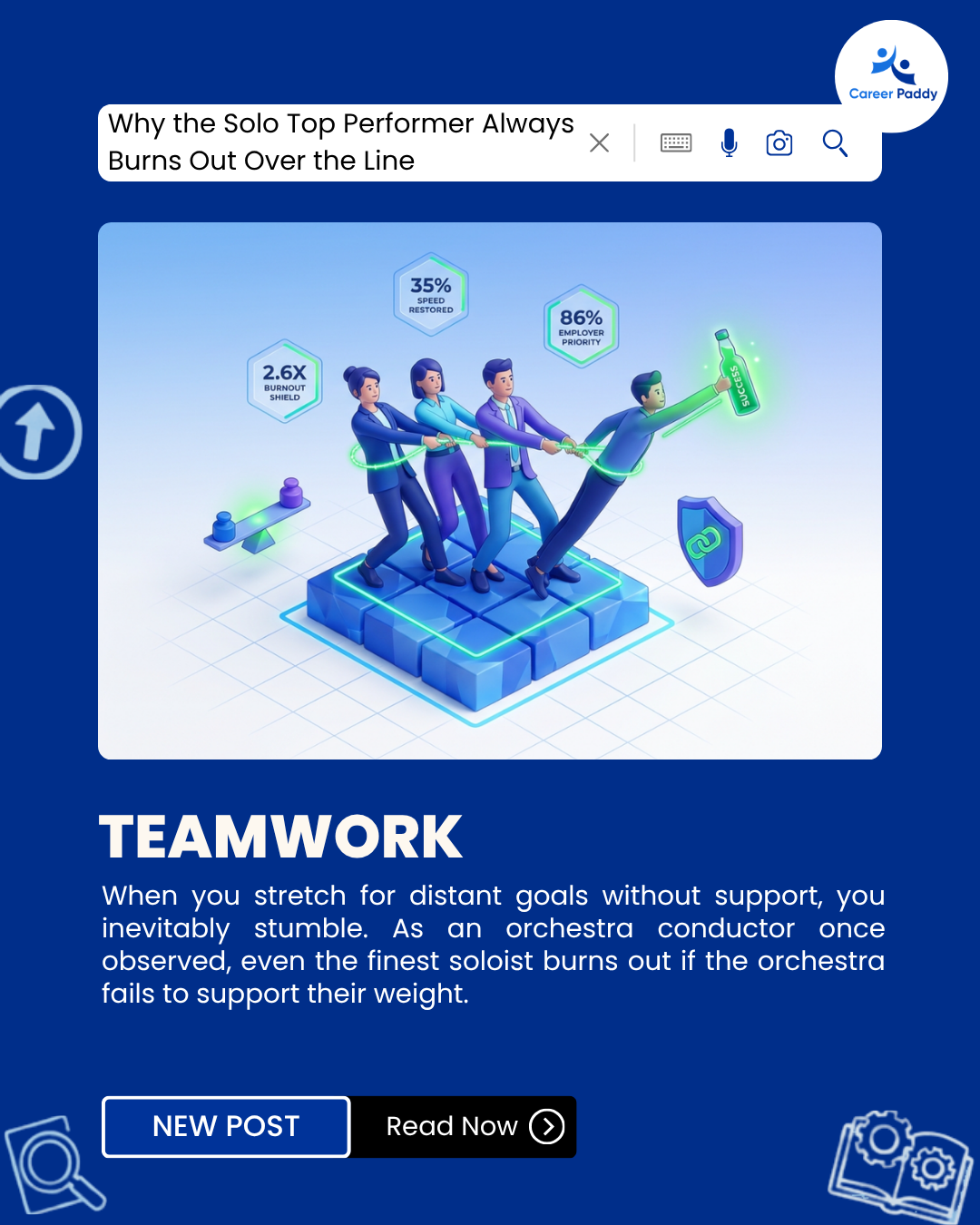
Why the Solo Top Performer Always Burns Out Over the Line
I watched a team exercise called “Pick the Bottle.” A line is drawn on the ground. Several water bottles are placed a few feet beyond it. They sit just out of arm’s reach.
A single player steps up to the line. They stretch their body forward into empty air. They try to grab the bottles without stepping over the boundary.
Alone, the physics are impossible. The player immediately loses balance, crosses the line, and falls.
The Physics of the Reach
The player only succeeds when teammates stand firmly behind them. Colleagues lock their hands around their waist. They act as a solid physical counterweight.
The front person can now lean forward at a gravity-defying angle. They stretch out their arm safely and secure the bottle.
This game reveals a fundamental workplace truth: You can only reach as far as your team holds you.
Many early-career professionals fall into the “Lone Wolf” trap. They believe career growth is a solo sprint. They try to carry the entire workload alone.
When you stretch for distant goals without support, you inevitably stumble. As an orchestra conductor once observed, even the finest soloist burns out if the orchestra fails to support their weight.
Collaboration is not about vague cheerleading. It is the soft skill of Counterweight Architecture. It is the understanding that individual success relies on team stability and load sharing.
Why Interdependence Matters
The Psychological Safety Multiplier: Research from Google Project Aristotle proves that psychological safety is the top predictor of team success. Dependability matters far more than individual star power.
The Burnout Prevention Factor: Studies by Gallup Workplace Analytics show that solo top performers face a 2.6x higher burnout risk. Operating without peer support leads to rapid exhaustion.
The Collaborative Overload Tax: Research from the Harvard Business Review reveals that hoarding tasks slows delivery by up to 35%. Star contributors who do not delegate create severe bottlenecks.
The Leadership Filter: Over 86% of employers value team interdependence when choosing candidates for promotion (NACE Career Readiness Framework). Leaders look for team builders, not isolated heroes.
The Common Misconception
Many believe teamwork means everyone must do the exact same task. That assumption creates confusion and wastes individual talent.
True teamwork is about Asymmetric Leverage.
In the bottle exercise, not everyone stretches for the prize. Four people act as anchors so one person can reach.
Great teams balance different strengths. Some teammates provide visible outreach. Others build the operational foundation that keeps projects steady.
Solo effort has a strict ceiling. Interdependent leverage is limitless.
How to Master Counterweight Architecture
- Acknowledge Your Limits: Asking for support is not a sign of weakness. When a project exceeds your capacity, ask teammates to anchor key tasks. Reaching without counterweight is reckless execution.
- Be a Reliable Anchor First: Prove you can hold others before demanding the spotlight. High-trust teams rely on peers who execute background tasks flawlessly. Your reliability as an anchor earns you future support.
- Communicate Strain Early: Never wait until you are already falling to ask for help. Tell your team early when your workload gets heavy. Early warnings allow colleagues to adjust their support.
- Credit Your Foundation Publicly: When you achieve a goal, point back to the teammates who held your weight. Performers who hoard credit end up standing alone on their next stretch. Sharing praise strengthens your support network.
- Prevent Soloist Burnout: If you work fast, resist taking on every assignment alone. Share documentation and cross-train your teammates. Even a brilliant soloist depends on the orchestra to hold the tempo.
- Build Team Redundancy: In the West African workplace, sudden power drops and connectivity issues happen often. Never allow a critical deliverable to depend on one person. Train backup anchors across your team to keep projects moving.
In Summary
You can be the most talented professional in your company. But if you reach for ambitious goals without team support, you will eventually burn out.
Solo performers fail because they carry every burden alone. High-impact leaders thrive because they master the reach and the anchor.
Know when to ask for help. Take pride in supporting your colleagues. Never let your ambition outpace the strength of your foundation.
In a demanding workplace, you can only reach as far as your team holds you.
You can visit CareerPaddy for more practical resources on workplace survival skills.
Access survival courses on Teamwork & Interdependence on:
Career Paddy App on Play Store
Career Paddy App on Apple Store
Stay tuned for more career insights from CareerPaddy.
